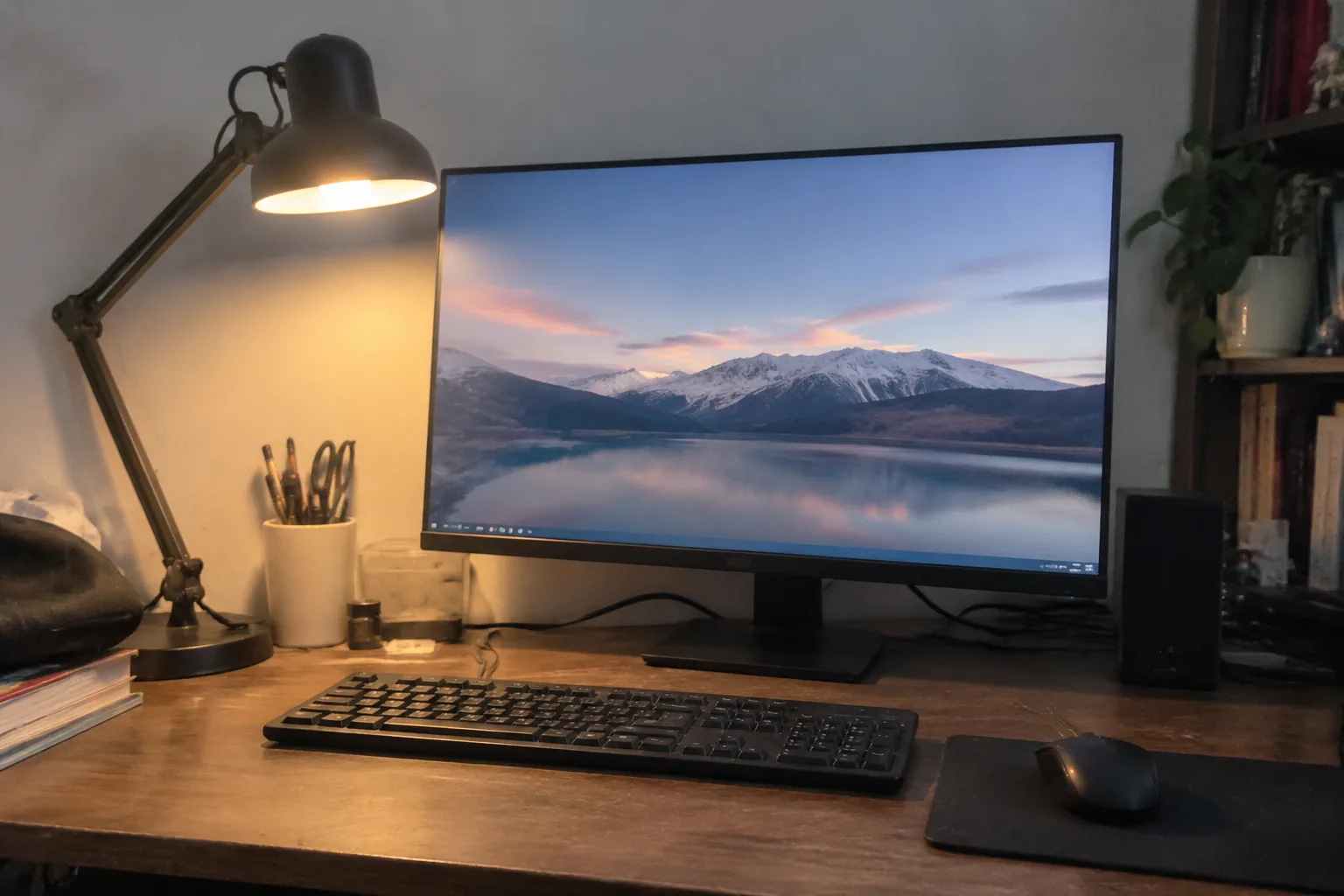
A monitor is the one part of a home office that people try to solve with whatever is already in the closet. The laptop screen gets propped on a stack of books, an old television gets dragged in from the garage, and then eight hours a day are spent squinting at a panel that was never designed for reading text at arm's length. The budget of $300 sits in an awkward middle: above the disposable tier, below the professional displays, and crowded with models that look identical on a spec sheet and behave very differently on a desk.
The good news is that $300 buys a genuinely comfortable working display in 2025. The bad news is that most of the buying advice out there optimizes for the wrong things. A 240 Hz refresh rate does nothing for a spreadsheet. A 1 ms response time is meaningless when the slowest thing in the chain is a person typing. What matters for a full day of work is resolution, panel type, stand ergonomics, and whether the thing can connect to a work laptop without a dongle graveyard forming on the desk.
What follows is a working shortlist, organized by the kind of work a person actually does, with the tradeoffs stated plainly. Prices move around, and sales are frequent, so treat the numbers as the ceiling rather than the floor.
The 27-inch 1440p class is the sensible center
For most home offices, a 27-inch panel at 2560 by 1440 is the sweet spot, and the reason is pixel density. At that size and resolution, text lands around 109 pixels per inch, which is sharp enough that spreadsheets and long documents stay crisp without scaling tricks. The physical footprint fits on a normal desk. The price fits under the ceiling.
The Dell UltraSharp U2724D sits near the top of the budget and earns it. The panel is IPS with a matte coating that handles a window behind the desk without turning into a mirror. The stand adjusts for height, tilt, swivel, and pivot, which sounds like a checkbox until the first week of neck strain argues otherwise. Dell's warranty and dead pixel policy are the quiet reason to pay a little more here: a single stuck pixel on a cheap panel becomes a permanent, maddening dot in the corner of the eye.
The HP E27 G5 is the slightly cheaper alternative and gives up a little color accuracy for a more aggressive price. For writing, email, and video calls, the difference is invisible. For anyone touching photos or design files, it is not.
One caution about this class: many 27-inch 1440p monitors at the bottom of the price range ship with flimsy stands that wobble when the desk is bumped. Check whether the stand is height adjustable before buying, or budget for a VESA arm, which is often the better purchase anyway.
Ultrawide panels trade desk space for screen real estate
A 34-inch ultrawide at 3440 by 1440 changes how a desk feels. Two documents sit side by side at full width. A spreadsheet and a video call coexist without window shuffling. The aspect ratio is closer to how people actually work than two separate monitors, and there is no bezel splitting the middle of the view.
The catch is price and desk depth. Under $300, ultrawides usually mean a 29-inch panel at 2560 by 1080, which is a noticeable step down in vertical space, or a refurbished 34-inch. The LG 34WP500 and similar entry models hover near the ceiling during sales. A 34-inch panel also wants about 30 inches of viewing distance, which means the desk needs to be deep enough that the far corners of the screen stay readable without head turning.
For anyone whose day is mostly one document at a time, the ultrawide is overkill. For anyone living in timelines, code editors, or trading dashboards, the extra horizontal space is the single biggest quality-of-life upgrade available in this budget.
24-inch 1080p still has a place, with conditions
A 24-inch 1080p monitor is the cheapest path to a second screen, and for a laptop user who just needs somewhere to park email and a chat window, it does the job at $120 to $150. The Dell P2422H and the ASUS ProArt PA248QV both sit in this range, and the ASUS is the better pick for anyone doing color work, since it ships with factory calibration and covers most of the sRGB gamut.
The condition is text sharpness. At 24 inches and 1920 by 1080, pixel density drops to about 92 ppi, and small fonts start to look soft next to a modern laptop screen. Reading a long document on one all day is a step backward from the laptop panel it is meant to supplement. This size works as a secondary display, not as the primary one.
Ports and cables decide more than the spec sheet
A monitor that requires three cables and a display adapter to connect to a work laptop will cost more in daily friction than the $40 saved on the panel. Look for USB-C with DisplayPort alt mode and power delivery, ideally at 65 watts or higher, so a single cable charges the laptop and carries the video signal. That single-cable setup is the difference between sitting down to work and untangling a nest every morning.
The Dell U2724D includes USB-C with 90 watts of power delivery, which is generous for the price. The HP E27 G5 offers USB-C at 65 watts on some configurations, so check the exact model number, because the same family name gets reused across variants with different port loadouts. This is where budget monitors cut corners most aggressively: a USB hub with two ports, no power delivery, and no downstream charging.
A built-in USB hub is worth having even at the cost of a slightly worse panel. Plugging a keyboard, mouse, and webcam into the monitor rather than the laptop means one cable to connect and disconnect at the start and end of the day. That small ritual matters more than it sounds.
Ergonomics is not a luxury feature
The top edge of a monitor should sit roughly at eye level, and the screen should be about an arm's length away. A stand that does not adjust in height forces the desk, chair, or a stack of books to do the work instead. This is why a $250 monitor with a proper stand beats a $200 monitor with a fixed one: the difference gets paid back in neck comfort within the first month.
Height adjustment, tilt, swivel, and pivot are the four to check. Pivot, the ability to rotate to portrait, is genuinely useful for anyone reading long documents or code. If the chosen monitor lacks these, a VESA-compatible monitor arm at $40 to $60 solves the problem and frees desk space at the same time. The arm is often the smarter purchase than upgrading the panel.
One more ergonomic note that gets overlooked: a matte screen finish reduces glare from windows and overhead lights. Glossy panels look impressive in a showroom and become a mirror in a room with a window behind the desk. For a home office, matte wins.
Panel types, briefly and without the mythology
IPS is the default for office work, and it earns the reputation: wide viewing angles, accurate color, and consistent brightness across the screen. VA panels offer deeper blacks and higher contrast, which makes them better for dark-room movie watching and worse for text, since VA has a reputation for smearing in fast motion and shifting color at off angles. TN panels are the cheapest and the worst for this use case, with narrow viewing angles that make a large screen look uneven from a normal sitting position.
The practical rule for a work monitor under $300: buy IPS, ignore contrast ratio marketing, and check for flicker-free backlighting if eye strain is a concern. Many budget panels use pulse-width modulation to dim the backlight, which some people find fatiguing over a long day. Reviews that measure flicker are worth seeking out.
Refurbished and open-box units stretch the budget furthest
The most underused move in this price bracket is buying a refurbished or open-box business-class monitor. Dell, HP, and Lenovo all sell certified refurbished units with the same warranty as new, often at 30 to 40 percent off. A refurbished UltraSharp at $220 delivers more panel, better ergonomics, and better ports than a new consumer model at the same price.
The tradeoff is patience and variance. Stock comes and goes, and the box may arrive with a scuff. But the panel inside is the same panel, and for a home office that sits on a desk for five years, the cosmetic condition of the bezel is irrelevant.
What $300 does not buy, and why that is fine
At this budget, there is no HDR worth the name, no wide-gamut coverage for professional color grading, and no 4K at a comfortable size. A 27-inch 4K panel under $300 exists, but the scaling required to make text readable at that density eats the extra resolution, and the panels at that price tend to be dim and uneven. The honest framing: $300 buys a very good 1440p office monitor and a mediocre 4K one. The 1440p is the better tool.
The other thing the budget does not buy is future-proofing. USB-C with 90 watts and a good stand today will still be a good monitor in five years, which is a longer useful life than most laptops get. Buy for the work being done now, not for a spec sheet that will be obsolete before the panel is.
A final concrete choice: for a writer, coder, or analyst working alone at a desk, the Dell U2724D at the top of the budget is the safe answer, and a refurbished unit makes it the smart one. For anyone who lives in multiple windows at once, a 34-inch ultrawide on sale is the more interesting answer, provided the desk is deep enough. And for the laptop user who just needs a second screen for chat and email, a 24-inch panel at $150 is enough, as long as nobody expects to read a novel on it.


