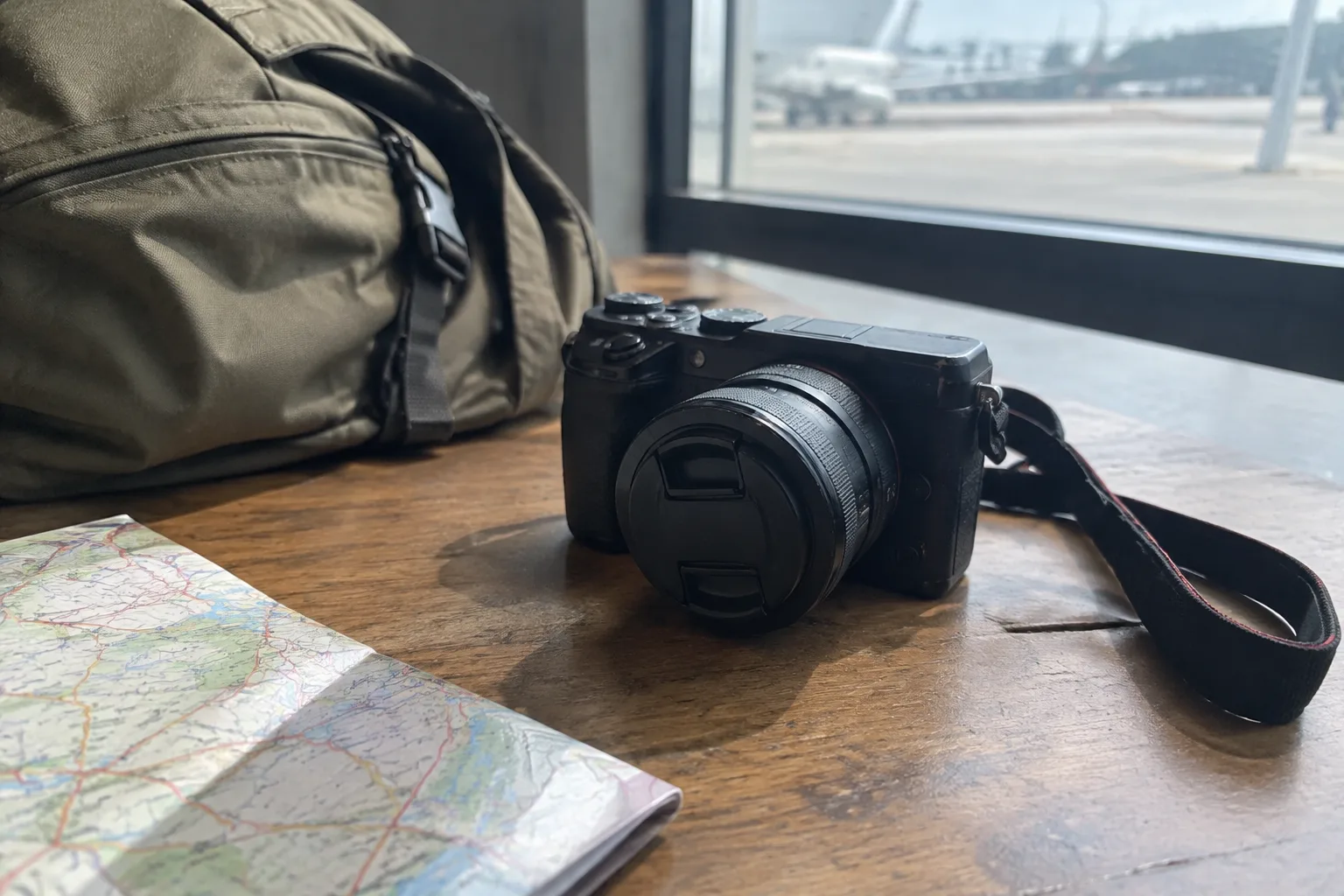
The travel camera market has spent the last decade convincing ordinary people that they need a full-frame sensor and a bag of prime lenses to photograph a coastline. They do not. A mirrorless camera bought for a two-week trip has to survive an overhead bin, a rain shower, and the moment when a person would rather eat lunch than fiddle with dials. The trick to buying one without overpaying is to spend money where the trip actually touches the camera and refuse to spend it anywhere else.
Most of the money in a mirrorless kit sits in three places: the sensor, the lens mount ecosystem, and the viewfinder. Two of those matter enormously for travel. One of them barely matters at all, and it is usually the one salespeople lead with.
The sensor size question, stripped of romance
Full-frame sensors gather more light and produce cleaner files in a dark restaurant. They also make every lens bigger, heavier, and more expensive, because the glass has to cover a larger circle. For a camera that lives in a daypack, that trade is often a bad one. A modern APS-C body with a decent kit zoom weighs maybe 600 grams. A full-frame body with an equivalent zoom runs closer to a kilogram, and the lenses cost two to three times as much.
The honest position: Micro Four Thirds and APS-C are the sensible travel formats. They are light enough to carry all day without resentment, and their sensors are far better than the internet's contempt suggests. A cloudy morning in a coastal town does not require a full-frame sensor. It requires a lens that opens to f/2.8 and a person willing to hold still.
Full frame earns its place for night markets, dim interiors, and anyone who genuinely prints large. If the trip is mostly daylight and the output is mostly a shared album, the extra sensor area is money spent on a capability that never gets used.
Where the lens budget actually belongs
A cheap body with a good lens beats an expensive body with a bad one, every single time. This is the oldest advice in photography and it remains the most ignored, because bodies are exciting and lenses are homework.
For travel, one zoom covers most of the ground. A standard zoom in the 24 to 70 mm equivalent range handles streets, portraits, food, and architecture. The temptation is to buy the body and the kit lens together and call it done. That kit lens is usually fine in good light and miserable at dusk, which is precisely when travel photographs get interesting.
A better plan: buy the body alone and put the savings into a single faster zoom, or a fast prime around 35 mm equivalent. One good lens that a person actually enjoys using will produce more keepers than three lenses that stay in the hotel room because the bag got heavy.
The viewfinder is not a luxury
Some budget mirrorless bodies ship without an electronic viewfinder, relying on the rear screen alone. On a bright afternoon at a beach or a snowy overlook, that rear screen becomes a mirror. Composition turns into guesswork. The photographer holds the camera at arm's length, squints, and hopes.
An EVF lets the camera come to the eye, which stabilizes the shot and blocks the sun. It also shows the exposure before the shutter fires, which is genuinely useful for anyone still learning. Skipping the viewfinder saves perhaps a hundred dollars and costs a whole category of photographs. Pay for the viewfinder.
Weather sealing and the trip that gets rained on
Weather sealing is the specification most likely to be misunderstood. A sealed body resists splashes and dust. It does not survive a dunking. The sealing only works when the lens is sealed too, which means the cheap kit zoom often defeats the whole point.
For a trip that involves boats, drizzle, or dust, sealing is worth real money. For a city break in summer, a plastic bag and a little caution cost nothing. Buy sealing if the itinerary demands it. Do not pay for it because a review called it essential.
Autofocus speed matters more than megapixels
Megapixel counts sell cameras. They rarely improve travel photographs. A 24-megapixel file is plenty for a print at A3 and generous for screens. A 40-megapixel file eats storage, slows the buffer, and demands better lenses to show any benefit.
What actually ruins a travel shot is a missed focus. A camera that locks onto a face quickly and tracks a moving subject reliably is worth more than any resolution bump. When comparing two bodies at similar prices, the one with the better autofocus system wins for travel, full stop.
Battery life and the spare that saves an evening
Mirrorless cameras drain batteries faster than the old DSLRs because the sensor and viewfinder run constantly. A day of shooting can eat one battery and start on a second. Two spares and a small charger cost less than a single good lens and prevent the specific misery of watching a sunset with a dead camera.
Check whether the body charges over USB-C. A camera that tops up from a power bank means one less charger in the bag and one fewer cable to forget. It is a small feature with outsized value on the road.
Buying last generation on purpose
The single largest saving available to a travel buyer is the previous model. Camera generations improve incrementally. A body that was flagship two years ago still takes the same photographs it did then, and it now sells for half its launch price. The autofocus might be one generation behind. The sensor is identical.
This is where discipline pays. The newest body arrives with a marketing campaign and a price to match. The model it replaced sits on the same shelf, discounted, with most of the capability. For travel, where the camera is a tool rather than a status object, the older body is the better purchase almost every time.
What the used market changes
A used body from a reputable dealer, with a warranty and a return window, can cut the cost of a kit by a third. Lenses hold their value well and used glass is often indistinguishable from new. The risk is a shutter that has fired a hundred thousand times or a sensor with dust welded to it.
Buying used from a private seller saves more and carries more risk. For a first travel camera, the dealer warranty is worth the premium. For a second body or a supplementary lens, the private market is fine for anyone willing to inspect carefully and walk away from a bad deal.
The accessories that quietly cost the most
The camera and lens are the visible spend. The bag, the memory cards, the spare batteries, the filters, and the strap add up fast and are easy to over-buy. A single decent shoulder bag, two fast memory cards, two spare batteries, and a clear filter for protection cover almost every travel need.
Polarizing filters earn their place for landscapes and water. ND filters are a specialist tool that most travelers will use twice. A tripod is the item most often bought and least often carried. Skip it unless the trip has a specific purpose that requires one.
The camera that gets carried is the camera that gets used
Every specification argument runs into the same wall: the best camera is the one that leaves the hotel room. A body that is slightly too large, slightly too heavy, or slightly too precious stays in the bag while a phone takes the photographs. The most expensive camera in the world is worthless if it is not there when the light turns gold.
That is the final filter for any purchase decision. Pick up the body. Mount the lens. Imagine carrying it for six hours through an airport and a market. If the answer is a sigh, the camera is wrong, no matter what the reviews say. The right travel mirrorless camera is the one that feels light enough to bring and good enough to trust, and everything else is a detail to be negotiated around that single fact.