The wire behind the wall is the whole problem, and it is a small one: a single strand, usually blue, that carries a trickle of power from a furnace or air handler to a thermostat. Without it, a smart thermostat has nothing to drink. The device wakes up, asks for current, gets nothing, and either refuses to boot or runs its screen on battery until the battery dies in the middle of a cold snap. This is the situation in a large share of older houses, particularly those built before the 1980s and particularly in the Northeast and Midwest, where heating systems were installed by contractors who saw no reason to run a wire for a feature that did not yet exist.
The good news is narrower than the marketing suggests. Four wires at the thermostat, labeled R, W, Y, and G, are enough for a conventional forced-air system, and a handful of smart thermostats are built to run on exactly that. The bad news is that the category is crowded with devices that claim compatibility and then quietly demand a fifth wire, or a C-wire adapter, or a professional install that costs more than the thermostat itself. Sorting the honest options from the ones that will leave a homeowner staring at a blank screen requires knowing which trick each device uses to steal power.
Why the missing wire matters more than the spec sheet admits
A thermostat without a C-wire has to power itself by borrowing current from the heating and cooling control circuits. The trick works because those circuits are not simple switches; they are low-voltage loops that a clever device can sip from during the brief moments when the system is idle. The catch is that the borrowing has to be timed carefully. Pull too much current through the heating circuit and the furnace thinks the call for heat is still active. Pull too little and the thermostat's radio and screen go dark.
Every manufacturer solves this differently, and the differences matter. Some devices use a power-stealing circuit that is genuinely elegant and works on most older systems. Others ship with a small adapter that gets wired in at the furnace control board, which is a fifteen-minute job for someone comfortable with a screwdriver and a breaker panel, and a two-hour job for everyone else. A few simply require the wire and say so. Reading the installation manual before buying is the single most useful thing a shopper can do, and almost nobody does it.
The Google Nest Thermostat, fourth generation, and its quiet compromise
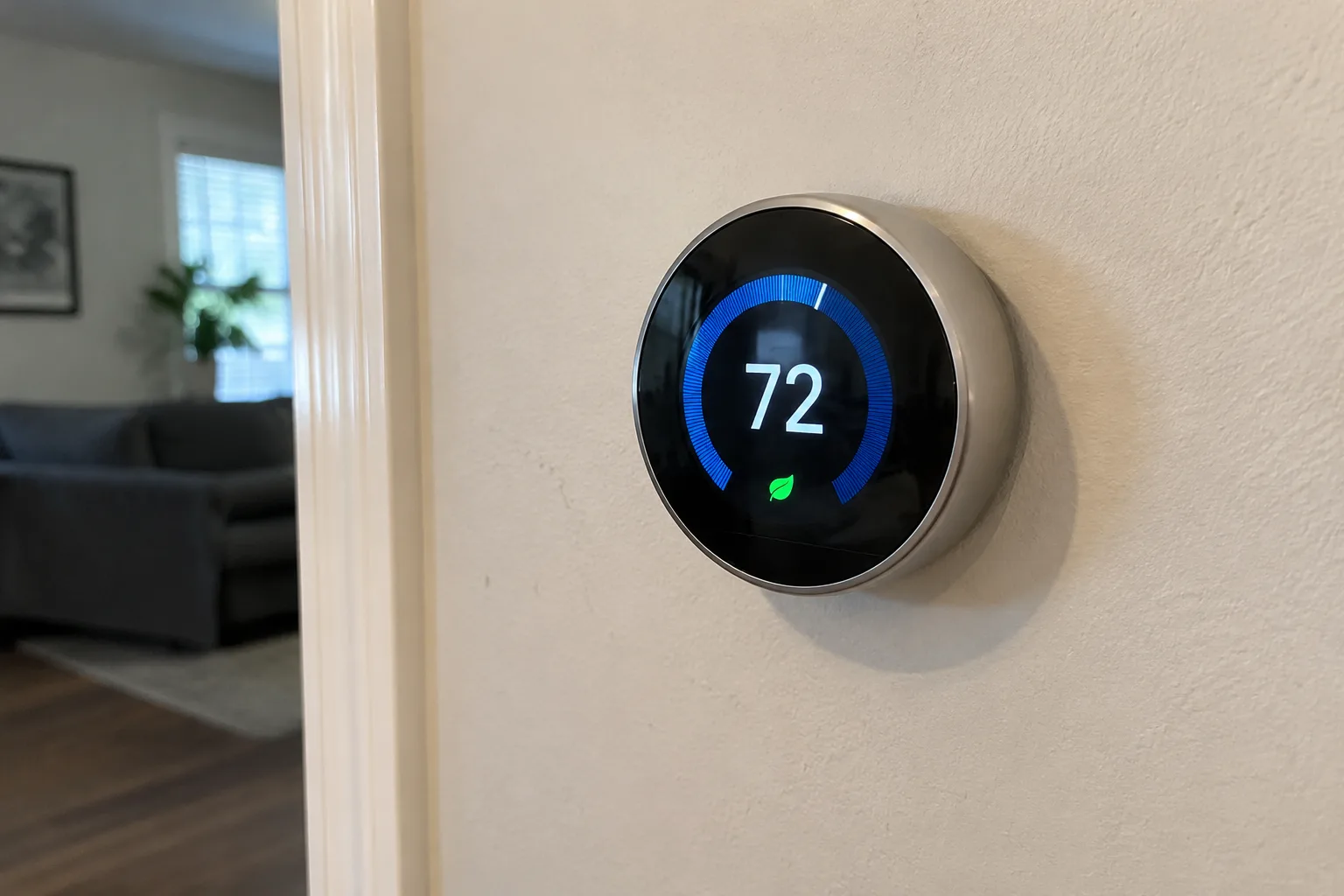
Nest's current mainstream model, the one sold without the mirrored finish, is the most common answer to the no-C-wire question, and it earns the reputation with a caveat. The device can run on four wires using a power-stealing approach, but it also ships with a small adapter called a Nest Power Connector that installs at the HVAC control board. Google recommends the connector for systems without a C-wire, and the recommendation is not decorative. Without it, the thermostat may work fine for weeks and then drop off the network during a heat wave, when the air conditioner runs long enough that the power-stealing circuit cannot find a gap to recharge.
The Nest's appeal is the software. The learning schedule is genuinely useful after the first two weeks, the presence sensing works, and the energy history gives a homeowner a real picture of how the house behaves. The hardware is pleasant without being precious. The catch is that the Power Connector adds a step, and that step involves opening the furnace panel, which is the part of the job most people would rather avoid. A homeowner who is comfortable with that panel will find the Nest a satisfying device. One who is not should budget for an installer.
Ecobee's approach: the adapter in the box
Ecobee ships its Power Extender Kit in the box with every thermostat it sells, and that single decision makes it the least anxious choice for a four-wire house. The kit is a small module that wires into the furnace control board and creates a virtual C-wire from the existing conductors. The installation is well documented, the kit is included rather than sold separately, and the company's support line is staffed by people who will walk a nervous homeowner through the terminal labels one at a time.
The thermostats themselves are competent rather than thrilling. The remote sensors are the real feature, particularly in a house with a bedroom that runs ten degrees colder than the hallway where the thermostat is mounted. The screen is responsive, the app is solid, and the build quality is good. The aesthetic is a bit corporate, a black slab with a white ring, and it does not disappear into a wall the way some competitors do. For a house where the wiring is the obstacle, though, the included adapter is worth more than any design consideration.
Honeywell Home's T9 and the professional-install assumption
Honeywell's consumer line, now sold under the Resideo name, has a reputation for reliability that is mostly deserved and a reputation for installation friction that is also mostly deserved. The T9 can run without a C-wire on some systems, but the company's own documentation steers most four-wire installations toward a professional. The device itself is excellent: the display is sharp, the geofencing works, and the integration with the wider Honeywell ecosystem is deep. It is the thermostat a contractor recommends because it rarely generates callbacks.
That reliability comes at a price, and the price is not just the sticker. A homeowner who buys a T9 for a four-wire house should plan on paying an installer, and the installer's fee can easily equal the cost of the thermostat. The math only works if the house already needs a service call for something else, or if the homeowner values the contractor relationship enough to pay for the peace of mind. For a confident do-it-yourselfer, the Ecobee is the easier path. For someone who wants the job done once and never thought about again, the T9 with a professional install is a reasonable splurge.
The Amazon Smart Thermostat and the budget question
Amazon's own-brand thermostat, made in partnership with Honeywell, sells for less than half the price of the competition and includes a C-wire adapter in the box. The device is plain, a white plastic square with a small screen, and the software is basic. It works with Alexa, it schedules, it reports energy use. It does not learn, it does not sense presence particularly well, and the app is the Alexa app, which is fine for people already in that ecosystem and irritating for everyone else.
What the Amazon device gets right is the honesty of its positioning. It is a cheap thermostat for a house without a C-wire, and it does not pretend to be a premium product. The adapter installs at the furnace, the instructions are clear, and the whole job takes about half an hour. For a rental unit or a starter home where the priority is a programmable schedule and a phone app, it is hard to argue with the price. For a house where the thermostat is a visible object in a hallway, the plastic looks like plastic.
The adapter question, and when to call a professional
The furnace control board is the part of the job that separates a satisfying Saturday project from a service call. The board sits behind a panel, usually held by two screws, and the terminals are labeled with letters that correspond to the thermostat's wires. The adapter installs by moving a few of those wires and adding a couple of jumper connections. The work is not difficult. The risk is real, because the board carries line voltage on some terminals and a mistake can fry the transformer or, worse, leave the system in a state that a technician has to untangle.
A homeowner who has never opened a furnace panel should not start with a thermostat install. A homeowner who has replaced a light switch and is comfortable killing power at the breaker can manage the adapter. The middle group, the people who are handy but not confident, should watch a model-specific installation video before buying. The videos exist, they are usually ten minutes long, and they reveal quickly whether the job is a half-hour or a two-hour ordeal. That ten minutes is the best return on time in the entire purchase process.
Which four-wire thermostat fits which house
The honest recommendation depends less on the thermostat than on the house. A house with a single-zone forced-air system, a homeowner comfortable with a screwdriver, and a preference for good software points to the Nest with the Power Connector. A house with hot and cold rooms, a homeowner who wants remote sensors, and a preference for an included adapter points to the Ecobee. A house where the homeowner would rather not touch the furnace at all points to the Honeywell T9 with a professional install, and the higher total cost is the price of that decision.
The Amazon device fits a narrow but real niche: a rental, a starter home, a budget that does not stretch to the premium options. The one category that should be avoided is the cheap imported smart thermostat sold on marketplaces with no adapter in the box and no support line. Those devices often claim four-wire compatibility and then fail in the second month, and the return shipping costs more than the device. The established brands are not always better hardware, but they are reliably better at the part that matters here, which is the unglamorous business of making a thermostat work on a wire that was never meant to power it.
The furnace that ran fine for forty years
There is a particular kind of older house where the thermostat is mounted on an interior wall, the furnace is in a basement corner, and the wiring between them is a single four-conductor cable stapled to the joists. The system has heated the house through four decades of winters without complaint. The homeowner wants a thermostat that can be adjusted from a phone, and the wiring, which has been adequate for every previous generation of thermostat, is suddenly the obstacle.
The right answer for that house is not the most capable thermostat on the market. It is the one whose manufacturer has accepted that the four-wire house is normal and has built the adapter into the box, the instructions, and the support script. The technology is not the hard part. The hard part is respecting the house as it is, with the wire it has, and choosing a device that meets the house where it stands rather than asking the homeowner to remodel the walls for a feature that costs less than the drywall patch.