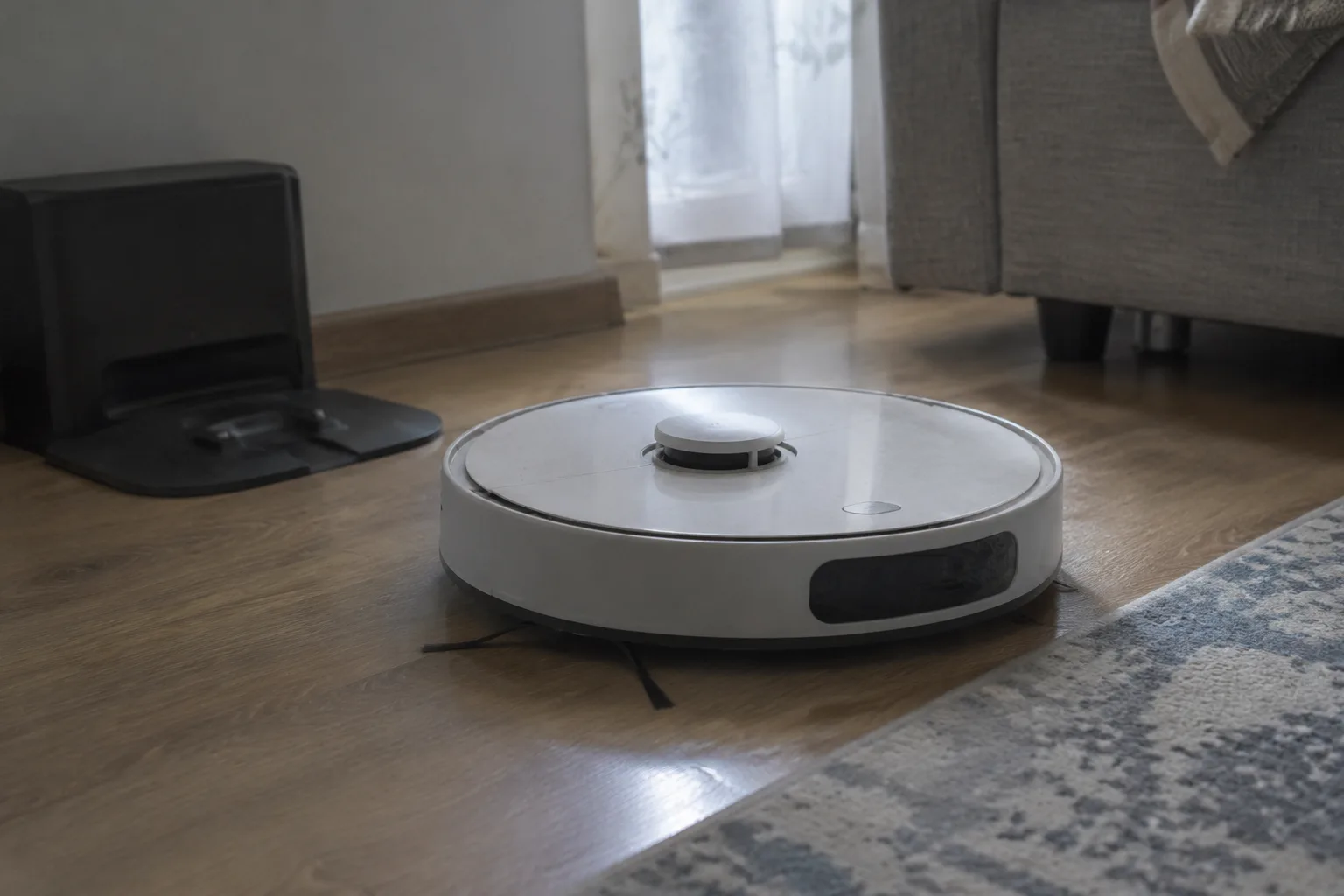
Two robot vacuums sit on a showroom floor, both priced within twenty dollars of each other. One carries a small spinning turret on top, a lidar puck that fires thousands of laser pulses a second and builds a millimeter-accurate map of the room. The other has a tiny camera behind a dark window on its bumper, a single eye that recognizes chair legs and doorframes and the difference between a cable and a baseboard. The specification sheets make them look like rival religions. In practice, the choice between lidar and camera navigation comes down to a handful of tradeoffs that most buyers never hear explained in plain terms.
What a spinning laser actually measures
Lidar works by time of flight. A diode emits a pulse of infrared light, the pulse bounces off a surface, and a sensor times the return to calculate distance. Because the assembly spins, it sweeps a 360-degree circle many times per second, producing a dense ring of distance points at a fixed height above the floor. Stack those rings as the robot moves and the software assembles a floor plan with surprising precision.
The consequences of that geometry matter more than the marketing. A lidar vacuum knows exactly how far the sofa is from the wall. It draws straight lines along the edges of a room and cleans them in orderly passes. When it returns to the dock, it does so along a path it has already measured, which is why lidar robots tend to dock reliably even in the dark.
The same geometry is the limitation. A single scanning plane at roughly the height of the robot's body sees the world as a flat slice. A curtain hanging to the floor registers as a wall. A low sofa skirt registers as a wall. A pair of socks on the carpet registers as a small obstacle worth avoiding, which is fine, but a charging cable lying flat on the floor often registers as nothing at all, because the beam passes over it.
The camera sees objects, not just distances
A camera-based system does something qualitatively different. It captures an image, and the processor runs a trained model over that image to classify what it is looking at. A chair leg, a pet bowl, a shoe, a trail of kibble: these are recognized as categories of object, and the robot can be instructed to avoid specific ones or to treat them gently.
That classification ability is the camera's genuine advantage, and it is not a small one. A lidar vacuum can tell that something is there; a camera vacuum can often tell what that something is. For households with pets, toddlers, or a chronic habit of leaving things on the floor, the difference shows up in how often the robot gets tangled, drags a sock across the kitchen, or smears something unfortunate into the carpet.
The costs are equally real. Cameras need light. Most current models pair the camera with an infrared illuminator so they can work in darkness, but the image quality degrades, and the classification confidence drops with it. A camera also has a narrower field of view than a spinning laser, so it depends more heavily on the robot physically turning to look around, which is slower and less certain.
The privacy question that never quite goes away
A camera pointed at the floor of a home is still a camera inside a home. Manufacturers have mostly settled on processing images on the device rather than uploading them, and several offer a physical shutter or a software switch that disables the camera entirely. Those mitigations are reasonable. They are also promises that depend on firmware behaving as described.
Lidar carries no comparable anxiety. A distance map of a living room reveals the layout of the furniture, which is not nothing, but it does not capture a face, a document on the floor, or the state of a bedroom. For some buyers this settles the decision before any performance comparison begins.
How each system handles a cluttered floor
Picture a living room on a Tuesday evening: a coffee table with a lower shelf, two phone chargers trailing across the rug, a pair of slippers, a dog bed, and a floor lamp with a heavy base. This is the ordinary battlefield.
A lidar robot maps the room cleanly and then works in disciplined rows. It will bump the slippers, decide they are an obstacle, and route around them. It will run straight over the phone chargers unless the bumper catches them, and then it will stop, reverse, and try again from a slightly different angle, sometimes for a while. The dog bed it treats as furniture. The lower shelf of the coffee table it may or may not enter, depending on whether the laser plane clears the shelf edge.
A camera robot with object recognition is more likely to spot the chargers as cables and avoid them, and more likely to recognize the slippers as something to leave alone. It is also more likely to hesitate, to slow down, and to make inefficient passes while it re-examines a corner. The clean is often a little less systematic. The floor is often a little less chaotic afterward.
Dark rooms and the limits of an unlit camera
Most camera navigation systems supplement with infrared, and in a dark hallway the robot still functions. The recognition accuracy, however, is not the same as in daylight. An infrared image is grainy and lacks color, which strips away some of the cues a model uses to tell a dark sock from a dark shadow. A camera robot scheduled to run at two in the morning in an unlit house will clean, but its obstacle avoidance gets noticeably more conservative and occasionally more confused.
Lidar has no such relationship with light. A pitch-black room produces exactly the same map as a bright one. For night-shift cleaning, or for homes where the robot runs while everyone is asleep, the laser has a structural edge that no amount of software polish fully erases.
Mapping speed and the first run in a new home
The first cleaning run in an unfamiliar house is where the two systems diverge most visibly. A lidar robot typically completes a full exploratory pass in a single session, producing a usable floor plan that the owner can then divide into rooms and label. The map is accurate enough that no-go zones and virtual walls land where they are supposed to.
A camera robot often needs more than one run to settle its map, and the plan can drift if furniture moves or lighting changes dramatically between sessions. Recent models have improved substantially by combining visual data with other sensors, but the first-week experience still tends to be fussier. Anyone who has watched a camera vacuum wander into the same hallway three times on its maiden voyage knows the feeling.
The hybrid machines and what they really are
Many current flagship vacuums carry both a lidar turret and a front camera, and the marketing presents this as having it all. The reality is more modest. The lidar handles mapping and localization, the camera handles object recognition, and the software arbitrates between them. That arbitration is where the quality lives. A well-tuned hybrid maps like a laser robot and avoids obstacles like a camera robot. A poorly tuned one inherits the hesitations of both.
The hybrid approach also raises the price, and it raises the privacy surface, since a camera is still present. Buyers who want lidar's reliability without a lens in the house should look specifically for single-sensor lidar models, which remain available and often cost less.
Which homes the camera suits better
A household with a tidy floor and predictable furniture gains little from object recognition. The camera's advantage shrinks to almost nothing when there is nothing unusual to recognize. In that setting, lidar's faster mapping, better edge cleaning, and reliable docking are the qualities that actually get used every day.
The camera earns its keep in messier homes: pets that scatter kibble, children who abandon toys, adults who leave bags and shoes in walking paths. There, the ability to identify and route around a specific object prevents the small disasters that make people stop using a robot vacuum altogether. A machine that gets tangled in a charging cable twice a week ends up parked in a closet.
The maintenance detail nobody mentions at checkout
The lidar turret is a moving part exposed to dust. Over months, a fine film accumulates on the window of the spinning assembly, and the map quality degrades in ways that are easy to miss: slightly wobbly paths, a room that takes longer to clean, a dock approach that suddenly needs two attempts. A cotton swab and thirty seconds restore it. Most owners never do it.
The camera window has its own version of this problem. A smudge on the lens produces recognition errors that look like software bugs. The robot stops avoiding the cable it used to avoid, and the owner concludes the firmware got worse. Cleaning the window fixes it. Neither system is maintenance-free, and the failure mode in both cases is a slow, quiet decline rather than a dramatic breakdown.
A practical way to decide
The decision hinges on one question: does the floor contain things that need to be recognized, or is it mostly open space that needs to be covered efficiently? Recognition favors the camera. Coverage favors the laser.
There is a second question worth asking, about when the robot will run. If it cleans at night in a dark house, lidar's indifference to light is worth more than any object-recognition feature. If it runs during the day while the household is awake and the lights are on, the camera is working under the conditions it was designed for.
And a third: how much does a lens inside the home matter? For some buyers that question outranks every performance metric on the box, and no amount of mapping accuracy answers it. The honest answer is that both technologies work, both have improved enormously in five years, and the choice is less about which is better in the abstract than about which failure mode a particular household can tolerate. A robot that maps beautifully but drags a sock through the kitchen is a worse purchase for a household with a sock problem than a slightly wandering robot that knows what a sock is.