Shutter actuations get all the attention. A seller lists a camera at 8,400 clicks, buyers nod approvingly, money changes hands, and three weeks later the same buyer discovers the sensor has a permanent dust scar from a botched wet clean, or the eyecup is held on with electrical tape. The number was fine. Everything around it was not.
Used mirrorless bodies have become genuinely good value. Five-year-old full-frame models that cost two thousand dollars at launch now trade for six or seven hundred, and they still make files that hold up against anything a hobbyist shoots. The catch is that mirrorless cameras age differently than DSLRs did. Fewer mechanical parts, more electronics, more things that can quietly degrade in ways a shutter count will never reveal. The five mistakes below are the ones that cost real money, and each one has a specific tell worth checking before cash leaves a hand.
Treating Shutter Count as the Main Health Metric
Mirrorless bodies wear out their shutters, yes, but a mechanical shutter rated for 200,000 cycles that has fired 30,000 times is usually not the component that fails first. The failure points on a used mirrorless camera tend to be the sensor stack, the EVF panel, the IBIS mechanism, and the ports. Shutter count says almost nothing about any of them.
Worse, the count is trivially reset on many models, and on others it never surfaces in the file metadata the way it does on a DSLR. A seller quoting a precise number is often quoting whatever the camera's menu displays, which may reflect only a portion of the camera's actual use, or a factory reset. The number reads as precision. It functions as decoration.
What a buyer can actually verify: the wear on the hot shoe (scraped paint means a flash or trigger lived there), the condition of the rubber grips (shiny and polished means heavy hand time), the USB and HDMI port flaps, and the tripod socket, which shows brassing fast on a camera that spent its life clamped to a plate. Those are honest witnesses. A menu counter is not.
Skipping the Sensor Inspection Under Actual Light
A sensor with dust is a cleaning job. A sensor with scratches or a damaged coating from a clumsy wet clean is a several-hundred-dollar repair, and on some bodies it approaches the cost of the camera itself. The two look similar in a dim room and completely different under a bright, small light source.
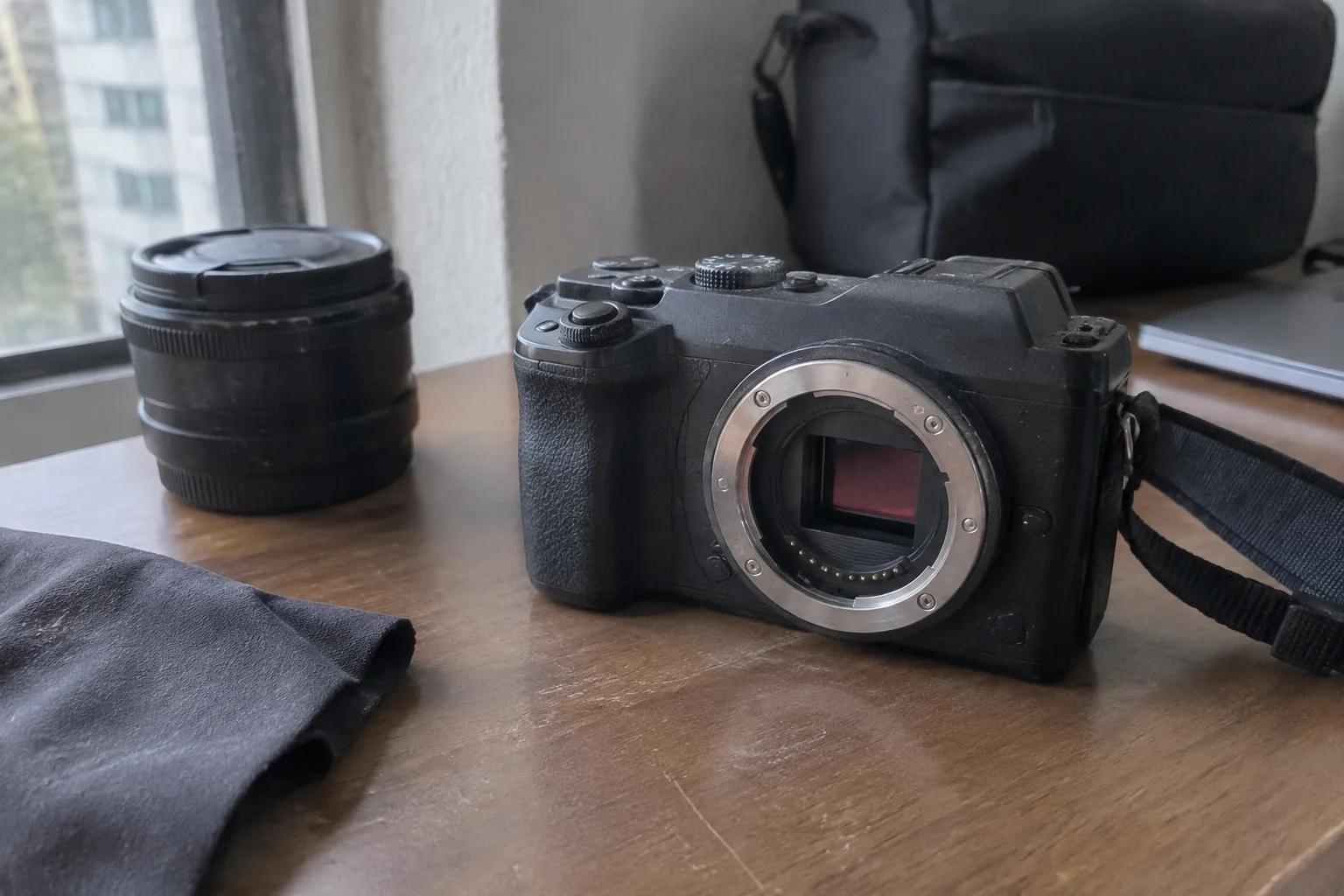
The inspection takes thirty seconds and almost nobody does it. Set the camera to a small aperture, f/16 or f/22, point it at a blank white wall or a sheet of paper, and shoot slightly out of focus. Then zoom into the resulting frame on the rear screen. Round, soft-edged spots are dust, usually fine. Anything that looks like a smudge, a streak, or a hard-edged mark that does not move between two shots taken after a few lens changes deserves a second look at full magnification. Hairline scratches on the sensor cover glass show up as thin dark lines that stay in exactly the same place.
Bring a small flashlight. Tilt it across the sensor at an angle with the lens off and the camera powered down. Dust sits on the surface. Scratches catch the light. The seller may find this fussy. The seller is not the one who will be paying for a sensor replacement.
Ignoring Stabilization Rattle and the Sound It Makes Powered Down
In-body image stabilization is one of the great gifts of the mirrorless era, and it is also a mechanical assembly suspended on tiny electromagnetic mounts that can be damaged by a drop, a hard knock, or years of vibration in a bag. A camera with a failing IBIS unit may still produce sharp photos in good light and only reveal itself as blurry frames at slow shutter speeds, which is exactly the situation where the buyer needed stabilization to work.
Many IBIS cameras rattle audibly when powered off and shaken gently. That rattle is normal on a healthy body, because the sensor is parked loosely. It should stop or change distinctly the moment the camera powers on and the mechanism clamps into place. If the rattle continues identically with power on, or if the camera makes a grinding or scraping sound when tilted while running, walk away from that body.
The functional test: shoot a few frames at a quarter second handheld with stabilization on, then again with it off, and compare. A working system buys two or three stops. A dead one buys nothing, and the buyer has paid for a feature that does not exist.
Buying a Body With a Battery That Cannot Be Replaced
Some mirrorless cameras, particularly the smallest and most compact ones, have sealed internal batteries that hold settings, clocks, and sometimes more. These cells age. When one dies, the camera forgets its date and settings every time it is powered down, and on a few models it refuses to operate correctly at all. On certain bodies the replacement is a professional repair. On a handful, it is effectively impossible.
This shows up in a used listing as a camera that asks for the date and time every single time it is switched on. Some sellers present this as a quirk. It is a dying cell, and it is a preview of what happens to the rest of the camera's consumable parts. A camera that resets its clock on every power cycle has a problem that will get worse.
The removable battery has its own tell. Ask how old the battery is and whether it is the original. A five-year-old lithium pack may hold half its rated capacity, which on a small mirrorless body means a couple hundred shots instead of four hundred. That is a fifty-dollar replacement hidden in the purchase price, and on cameras that use proprietary batteries, sometimes more.
Overlooking the Viewfinder, the Ports, and the Grip Adhesive
The electronic viewfinder is the part of a mirrorless camera that gets touched most and inspected least. Look through it against a bright background and check for dead pixels, uneven tint, or a hazy, washed-out image that suggests the eyepiece optics have clouded with oil and moisture. Some EVF panels develop a permanent purple or green cast that no setting fixes. It is a subtle defect that ruins every manual-focus session.
Port covers are the cheapest part on the camera and the most frequently broken. A missing USB flap exposes the internals to dust and sweat. Squeeze the rubber grips along their edges; if a corner lifts easily, the adhesive has aged out, and the grip will peel within months of regular use. That is cosmetic, but it signals how the rest of the body was treated.
None of these are dealbreakers individually. Together they tell a story about a camera's life, and the story matters more than the shutter count printed in the listing. A body with 40,000 clicks, tight grips, clean ports, and a scratch-free sensor is a better purchase than one with 9,000 clicks and a peeling grip, because the first camera was cared for and the second was merely used.
Paying the "Mint" Premium Without the Box, Caps, and Charger
A used camera listed as mint with no body cap, no charger, and no original box is priced as if those things exist. They do not. The buyer will spend thirty or forty dollars replacing a charger on models that no longer ship with one, and another ten on a body cap, and then discover the camera has been riding around in a bag with the sensor exposed. The missing cap is the tell. A camera whose owner lost the body cap probably did not baby the sensor.
Original packaging is not sentimental. It is evidence. Boxes with matching serial numbers, a charger still in its bag, a strap that has never been unwound: these are the fingerprints of a camera bought new, used gently, and stored properly. A mint price is defensible only when the camera arrives with the things a new camera arrived with. Otherwise the price should drop to reflect the missing pieces, and it rarely does unless a buyer asks.
Ask for the serial number and check it against the box. Ask for a photo of the battery compartment, which collects grit and corrosion. Ask when the last time the sensor was cleaned. A seller with nothing to hide answers all three in one message. A seller with something to hide answers one of them, badly, and that is the answer.
The Seller Who Won't Meet in Daylight With a Memory Card
Every test above requires the camera to be powered on, a lens mounted, and at least one photo taken and reviewed. That means the buyer needs a charged battery and a memory card. A serious seller expects this. A seller who wants to meet in a parking garage at night, hand over a bag, and take cash without the camera ever leaving the bag is not offering a deal. They are offering a problem with a price tag.
Bring a card and a lens if the body is sold without one. Shoot a dozen frames at different apertures and shutter speeds. Review them on the rear screen. Power the camera off and on twice. Set the clock. The seller who tolerates ten minutes of this is the seller worth buying from. The one who hovers and reaches for the bag is telling the truth in the only language that matters.