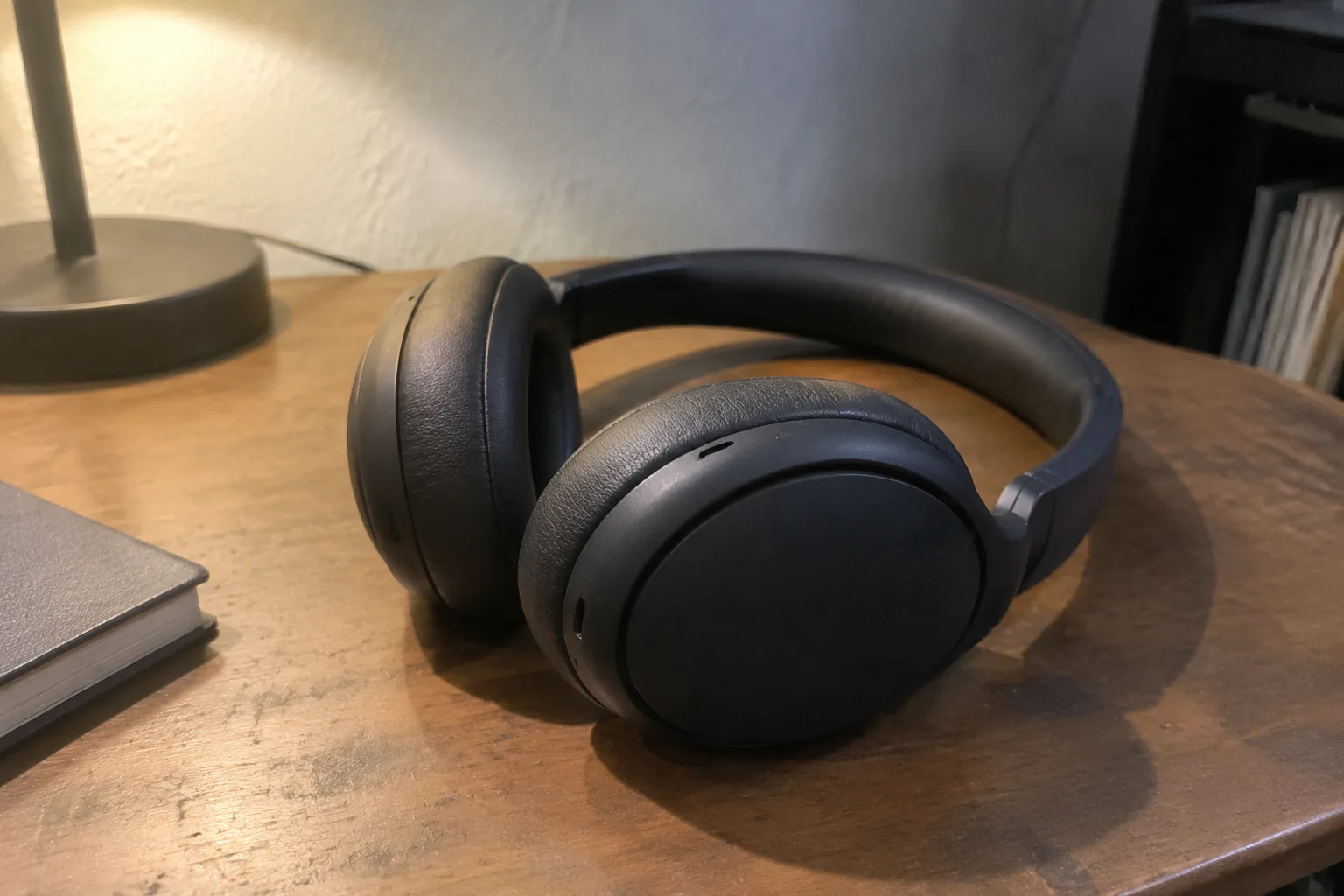
Two hundred dollars buys a pair of over-ear headphones that can silence a jet engine's worth of low rumble, and it also buys a pair that will crackle and die within eighteen months. The gap between those two outcomes has almost nothing to do with brand prestige and everything to do with three or four engineering decisions that manufacturers rarely advertise. The commuter market sits at exactly the price where those decisions get made honestly or dishonestly, which makes it the most interesting bracket in audio.
Active noise cancellation works by generating an inverse wave. That is the simple version. The practical version is that ANC has become a marketing word stretched to cover everything from a genuine two-microphone feedback system to a single feedforward mic that mostly muffles the 100 to 300 Hz drone of a bus engine and calls it a day. Under $200, a buyer is almost always getting the second thing. The question is which version of the second thing.
What the $200 ceiling actually excludes
The flagship tier, the Bose QuietComfort Ultra and the Sony WH-1000XM5 and the AirPods Max, sits between $350 and $550. What those models buy is not magic. They buy deeper low-frequency attenuation (the difference between muffling a train and genuinely erasing it), better handling of the mid-frequency band where voices and announcements live, and microphone arrays good enough to keep a phone call intelligible in a gust of wind. Some of that trickles down. Most of it does not.
What does trickle down, reliably, is battery life. The budget tier now routinely hits 40 to 60 hours per charge with ANC on, which beats several flagships. Manufacturers learned that a long battery number is the cheapest spec to win, so they win it. A commuter who charges once a week and forgets the cable exists has the budget tier to thank.
The other thing the ceiling excludes is build quality in the hinge. This is the quiet failure point. Every pair of folding headphones under $200 uses some variation of a plastic yoke that takes the full stress of being shoved into a bag twice a day. The plastic creaks before it cracks, usually around month fourteen.
The three models that keep coming up for good reason
The Sony WH-CH720N sits at roughly $130 and is the sensible default. It is light, almost absurdly so, and the clamping force is gentle enough for a two-hour train ride without a headache. The ANC is honest about its limits: it flattens HVAC hum and road noise and does very little about a crying baby. The plastic feels like plastic. The sound is warm and slightly bass-forward, which suits pop and podcasts and flatters badly mastered streams.
The Anker Soundcore Space One runs about $100 and punches above its weight on ANC, which is the family trait Anker built its reputation on. The mid-range cancellation is better than the Sony's, meaning announcements and chatter get pushed further back. The trade is a slightly hollow timbre and an app that insists on equalizer presets nobody asked for. For a loud subway commute, it is the better pick.
The JBL Tune 770NC hovers near $120 and does the thing JBL has always done well: a lively, slightly bright tuning that makes music feel like it has energy. The ANC is the weakest of the three. The fit is the most secure, which matters more than people admit, because ANC performance collapses the moment the earcup seal breaks and a pair of glasses or a thick knit hat will break it.
None of these three will survive being sat on. All three will survive a year of daily use if the bag has a pocket for them. That is the real contract at this price.
Why the earcup seal beats the spec sheet
Passive isolation, the physical blocking of sound by the cup and its padding, does more work than the electronics on most commutes. A pair with mediocre ANC and a good seal will outperform a pair with strong ANC and a leaky fit, every time, and the spec sheet cannot tell a buyer which is which. This is the single most under-discussed fact in budget headphone reviews.
The practical test is crude and effective: put the headphones on, play nothing, and listen to the room. If the ambient sound drops sharply, the seal is working. If the sound barely changes, the ANC is doing all the labor and the battery will pay for it. Earpad depth matters too. Shallow pads press the driver against the ear and produce a hot, fatiguing sound after an hour.
Commuters who wear glasses have a structural problem here. The temple arm lifts the pad and creates a leak, and no amount of software fixes a leak. Thicker, softer pads help. So does accepting that over-ear ANC will always underperform for glasses wearers, and that in-ear models with ANC, which seal inside the canal, sidestep the problem entirely.
The transparency mode nobody tests
Every commuter needs to hear a platform announcement, a gate change, or a car horn. Transparency mode pipes the outside world through the microphones, and budget implementations vary wildly. Some sound like a cheap speakerphone. Some add a faint hiss. The good ones are unremarkable, which is the highest praise.
This is where the Sony CH720N earns its keep. Its ambient mode is clean enough to hold a conversation without removing the headphones, and it does not over-amplify the clatter of a train carriage the way some cheaper systems do. The Anker's transparency is functional but slightly processed. The JBL's is the weakest, with a noticeable delay that makes the wearer's own voice sound like it is coming from another room.
A commuter who never uses transparency is paying for a feature and ignoring it. A commuter who uses it constantly should weight it heavily, because a bad implementation is worse than none at all.
Microphones for calls, and the wind problem
The call quality on all three models is acceptable indoors and poor outdoors in wind. This is a physics problem at the price. Wind hits the microphone and the software cannot distinguish it from voice, so it either mutes everything or lets the roar through. Flagships solve this with dedicated wind-noise reduction and beamforming arrays that cost more than the entire budget driver assembly.
For a commuter who takes calls while walking to the station, the honest advice is to accept the limitation. For a commuter who takes calls on a quiet train, all three are fine. The microphone test that matters is not a studio recording but a voicemail left at a busy intersection, and none of these will flatter that scenario.
The codec question, settled
Budget headphones support SBC and AAC, sometimes LDAC. The internet has spent years arguing about whether LDAC sounds better than AAC on a commute. It does not, because a commute is a noisy environment where the masking effect of train rumble erases the subtle high-frequency detail that high-bitrate codecs preserve. The difference is audible in a quiet room and inaudible on the Northern Line.
What matters more is connection stability. A codec that drops out when the train passes a certain signal relay is worse than a lower-bitrate codec that holds. Bluetooth 5.2 or later helps, and multipoint pairing, the ability to hold a laptop and a phone at once, is genuinely useful for anyone who works on the move. The Sony and the Anker both offer it. The JBL's multipoint is fussier to set up.
What breaks first, and when
The earpads go first. They compress, they flake, they lose their seal, and the ANC performance degrades with them. Replacement pads cost $15 to $30 and most people never buy them, choosing instead to live with a worsening experience until the headphones feel broken. A pair of pads swapped at month eighteen extends the life of a $130 headphone by two years.
The hinge goes second, usually after the pads. The battery goes third, and it goes slowly, so the wearer rarely notices the decline until a full charge stops lasting a week. The electronics themselves, the drivers and the ANC chips, almost never fail. A budget headphone dies of mechanical wear, not electrical death.
This changes the buying logic. A commuter should choose the model with replaceable pads and a hinge that feels solid in the hand, even if it costs $20 more and cancels slightly less noise. The spec sheet rewards cancellation. The second year of ownership rewards the hinge.
The case for spending $130 instead of $190
At the top of the budget bracket, around $180 to $200, the improvements over a $130 model are real but narrow: a bit more mid-range cancellation, a slightly nicer finish, one extra feature. The failure timeline barely changes. A $190 pair and a $130 pair both need new pads at month eighteen and both have a hinge that will not survive a bad drop.
The smarter allocation is $130 on the headphones and the remainder on a hard case and a spare set of pads bought in advance. That combination will outlast a $200 pair that gets stuffed into a backpack loose. Commuters optimize for the commute they take every day, and the daily commute is a story about wear, not about specs.
The best noise-cancelling headphone under $200 is the one whose seal still holds after two years of daily abuse, whose pads can be replaced for the price of lunch, and whose ANC is honest enough to flatten the drone that actually ruins the morning. That is a modest set of demands, and almost no spec sheet lists any of them.