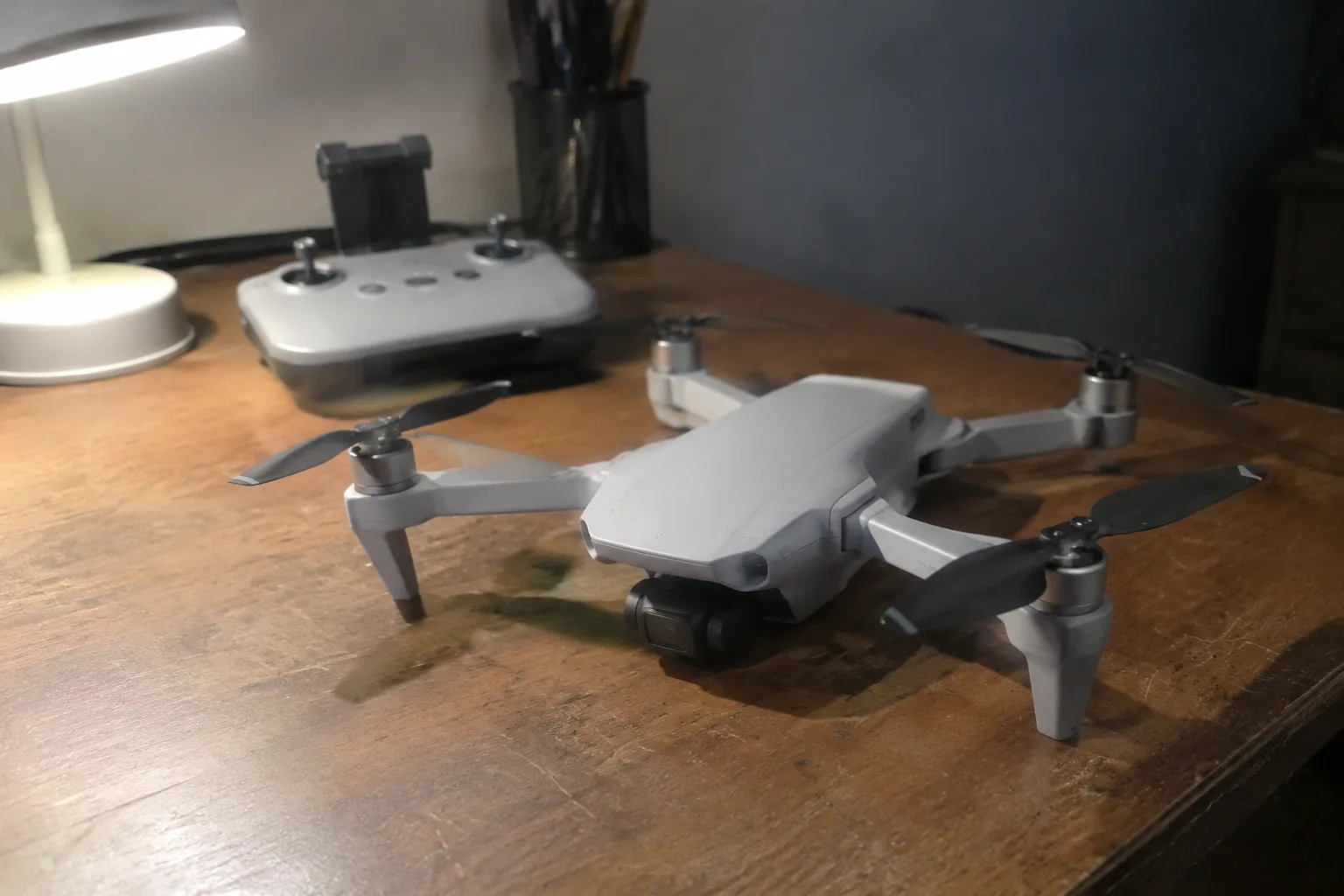
A beginner drone costs less than a decent pair of running shoes, and that fact trips up more first-time buyers than any spec sheet ever will. The cheap end of the market is crowded with machines that fly for eight minutes, drift in the slightest breeze, and send back video that looks like it was shot through a greasy window. The good news is that a genuinely useful starter drone exists at a genuinely low price. The bad news is that the features separating the good ones from the landfill fodder are rarely the ones printed in the biggest type on the box.
What follows is a buyer's guide built around a single idea: the money saved on a first drone should buy flight time and crash tolerance, not camera megapixels. A beginner crashes. A beginner crashes often, sometimes into a fence, sometimes into the ground, occasionally into a tree that appeared out of nowhere. The drone that survives those events and keeps flying is worth more than the one with the sharper sensor that dies on the third impact.
The real budget ceiling sits lower than the sticker price suggests
Budget is a slippery word in this hobby. A drone listed at 80 dollars is not an 80 dollar purchase once the spare batteries, propeller guards, and a decent carrying case are added. Batteries are the quiet budget killer. A spare flight battery for a budget quad often runs a third of the drone's price, and one battery means roughly ten minutes in the air before a long wait at the charger.
Factor two or three batteries into the total before comparing models. That recalculation often reshuffles the shortlist, because a slightly more expensive drone that ships with two batteries and uses a common connector can undercut a cheaper one that requires three separate purchases to fly for half an hour.
The practical ceiling for a true beginner setup, all in, tends to land somewhere between 100 and 250 dollars. Above that, the machines start demanding more skill and more nerve than a first-time pilot usually has. Below it, the hardware starts cutting corners that show up in the air.
Propeller guards are not optional accessories
Every budget drone should have propeller guards, either included or available cheaply. On the smallest indoor-friendly models the guards are molded into the frame. On slightly larger outdoor machines they clip on. Either way, they do two jobs: they protect the props from walls and branches, and they protect walls and branches from the props.
A first flight in a living room goes badly without guards. The drone drifts toward a lamp, the pilot overcorrects, and a bare propeller chips against the shade. With guards, the same mistake produces a soft bounce and a laugh instead of a cracked prop and a scuffed lampshade. That difference matters because confidence on the sticks comes from surviving small mistakes, and a nervous pilot flies worse than a relaxed one.
Brushless motors deserve a mention in the same breath. The cheapest drones use brushed motors, which are fine but wear out after a few dozen hours and are not worth replacing on a machine that cost 40 dollars. Brushless motors last far longer and handle wind better. A budget drone with brushless motors and prop guards is a much better long-term purchase than a cheaper one with neither.
Altitude hold changes how the drone feels in the hand
Older and cheaper drones require constant throttle correction. Let go of the stick and the drone sinks. Hold it slightly too long and the drone climbs. The pilot ends up fighting the machine just to keep it at eye level, which leaves very little attention for steering.
Altitude hold, sometimes called altitude lock, fixes this. The drone maintains its height when the throttle is released, so the pilot can concentrate on direction. For a beginner, this single feature does more to make flight feel controlled than almost anything else in the price range. It is the difference between a drone that hovers patiently while the pilot thinks and one that has to be babysat every second.
Headless mode is worth understanding too, though it divides opinion. In headless mode, the drone's controls follow the pilot's perspective rather than the drone's nose, which removes the disorienting moment when a drone facing the pilot suddenly reverses left and right. Purists argue it builds bad habits. For a first-time flyer trying to keep a small machine in sight over a park, it removes a whole category of panic.
Wind ratings on budget boxes are optimistic fiction
A drone advertised as handling 15 mph winds will, in practice, be a handful at half that. The rating usually describes the point at which the motors can still fight the gust, not the point at which the footage stays steady or the pilot stays calm.
Weight tells a more honest story. A drone under 250 grams gets tossed around by anything above a gentle breeze. That is not a flaw; it is physics. The lighter the machine, the more it bounces. A beginner should plan first flights for still mornings and open ground, and should treat any gust that moves tree branches as a signal to land.
The 250 gram line matters for another reason. In many countries, drones below that threshold fall into the lightest regulatory category, which often means fewer registration requirements and simpler rules. A beginner should check local rules before buying, because the exact cutoff and the paperwork around it vary by jurisdiction. Buying a drone just over the line can turn a simple hobby into an administrative project.
Camera specs mislead more than they inform
A 4K label on a 90 dollar drone means very little. The sensor behind that label is tiny, the lens is plastic, and the stabilization is either absent or electronic in a way that warps the edges of the frame. Footage from these cameras tends to look soft in the corners and jittery in any kind of motion.
For a first drone, 1080p is plenty. What matters more is whether the camera is stabilized, even electronically, and whether it can tilt remotely. A fixed camera pointing straight ahead limits every shot to the same framing. A camera on a one-axis gimbal that tilts up and down opens up simple compositions: a horizon, a subject from above, a slow reveal.
The honest framing for a beginner camera is this: it is a tool for learning to frame shots and judge light, not a tool for producing cinematic footage. A pilot who learns to fly smoothly with a modest camera will shoot better video than one who buys a sharper sensor and never learns to stop the drone from jerking.
Flight time claims assume a windless laboratory
Advertised flight times are measured in ideal conditions: no wind, moderate temperature, gentle hovering, no camera recording. Real flight time runs shorter. A drone claiming 15 minutes often delivers 9 or 10 in the park, and less in cold weather, where battery chemistry slows down.
The useful question is not the maximum flight time but the recharge time. A drone with a 10 minute flight and a 45 minute charge is frustrating to own. One with a 12 minute flight and a 30 minute charge is far more usable, especially with two batteries in rotation. Charging speed rarely appears on the box, but it shapes the whole experience of owning the thing.
Battery connectors matter here too. Proprietary connectors lock the owner into one brand's batteries at one brand's prices. A drone that uses a standard connector opens up cheaper third-party batteries and a faster path to a multi-battery rotation.
GPS is the dividing line between toy and tool
Below a certain price, drones fly without GPS. They rely on barometers and gyroscopes to hold position, which works indoors but drifts outdoors. A gust pushes the drone, and it does not know how to push back to the spot it was hovering over. It wanders.
GPS changes the character of the machine. It holds position against wind, returns to the launch point at the press of a button, and can be told to hover while the pilot looks away. For a beginner, the return-to-home function alone justifies the price jump. It turns a lost drone into a recovered one.
The trade-off is cost and weight. GPS modules add both, pushing the drone toward the top of the beginner budget. For flyers who intend to fly outdoors at all, it is the single upgrade worth stretching for. For those who will only ever fly in a gym or a living room, it is money better spent on spare batteries.
The controller in the box is half the purchase
A drone is only as good as the thing that steers it. Cheap bundles often ship with a controller that feels hollow, with sticks that wobble and a spring tension that varies from unit to unit. A wobbly stick translates into wobbly flight, and a beginner will blame the drone for a problem that lives in the transmitter.
Two things to check before buying: whether the controller has a phone mount, and whether the app that connects to the drone has a reputation for staying connected. A phone mount lets the pilot see the camera feed, which is the whole point of a camera drone. An app that drops the connection mid-flight turns a pleasant session into a scramble.
App quality is hard to judge from a product page, so it is worth reading recent reviews specifically about connectivity and updates. A drone with excellent hardware and an abandoned app is a drone that stops working the day a phone updates its operating system.
Buy the drone that can be repaired, not the one that cannot
The final question is what happens after the first hard crash. Some budget drones use modular parts: props that pop off, arms that unscrew, motors that can be swapped with a screwdriver. Others are sealed units where a broken arm means a broken drone.
Spare part availability is the quiet marker of a good budget model. A drone with cheap, widely available propellers and a documented way to replace a motor will outlast a marginally better-flying drone with no parts support. Before buying, search for the model's spare parts. If the only results are the drone itself, that is a warning.
The best first drone, in the end, is the one that survives long enough to teach its owner how to fly. That machine tends to be modest on paper: brushless motors, prop guards, altitude hold, a standard battery connector, GPS if the budget allows, and a parts catalog that still exists in a year. The flashier alternative, with the bigger number on the camera and the sealed shell, often ends up in a drawer by the second month. The difference between those two outcomes is rarely visible in the headline specs. It shows up in the third flight, when the pilot finally stops gripping the sticks and starts looking at the horizon.