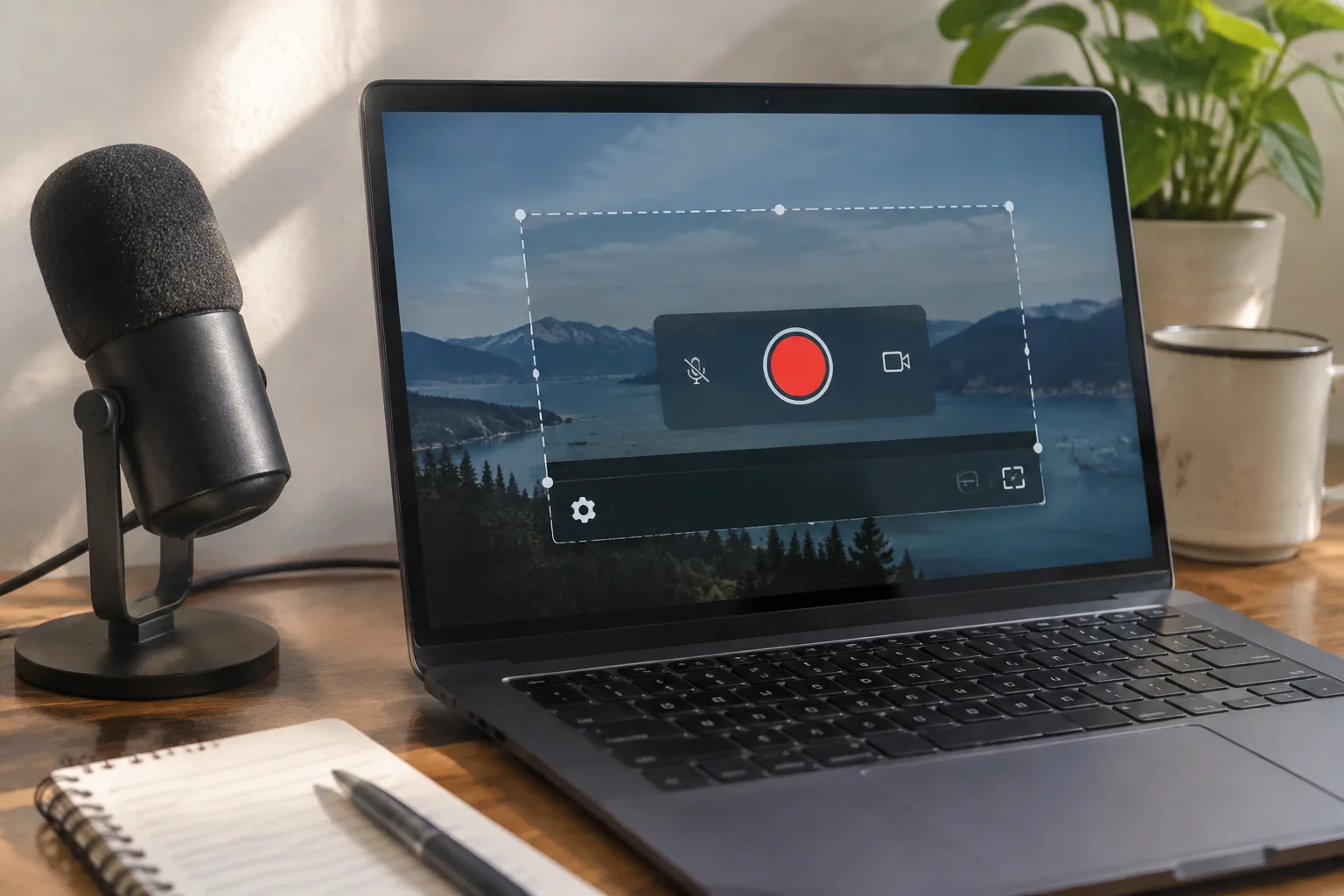
Screen recorders occupy a strange corner of the software market: they are sold as commodities, priced like utilities, and yet the differences between a good one and a bad one show up only after a recording has already been ruined. A webinar demo with silent audio. A tutorial where the cursor vanishes for three seconds every time the mouse moves fast. A bug report video that captures the crash but not the frame before it. The tool worked, technically. The recording did not.
What follows is a checklist of the things that separate a recorder worth installing from one that will waste an afternoon. None of it requires a benchmarking lab. Most of it can be tested in ten minutes with a single practice recording.
The frame rate claim on the box is not the frame rate of the file
Nearly every recorder advertises 60 frames per second. Many deliver it only in a narrow configuration: one monitor, a modest resolution, hardware acceleration switched on, no webcam overlay. Add a second display or a 4K canvas and the same tool quietly drops to 30, sometimes lower, without a warning dialog. The recording looks fine in a small preview window and turns into a slideshow on a projector.
A quick check settles it. Record two minutes of fast scrolling through a long document, then step through the result frame by frame. If cursor movement stutters or text smears between frames, the effective rate is lower than the spec sheet claims. This matters most for tutorials and software demos, where the viewer's eye is tracking small movements. A talking-head video at 30 fps is unremarkable. A coding tutorial at 30 fps is painful.
Audio sources: the system sound and the microphone are two separate problems
Screen recorders fail at audio in two distinct ways, and buyers tend to conflate them. The first is system audio capture, the sound coming out of the machine itself. The second is microphone capture, the voice narrating over it. Plenty of tools handle one cleanly and mangle the other.
System audio is the harder of the two on some operating systems, where the recorder needs a virtual audio driver to intercept output. When that driver is missing or misconfigured, the recording comes back silent on one channel, or with the system sound at a whisper while the microphone is clipping. The fix is rarely obvious from the interface.
The practical test: play a short music clip and speak over it at the same time, then listen back on headphones. Both sources should sit at usable levels without one drowning the other. A recorder that offers independent volume sliders for system audio and microphone, plus a live level meter for each, is worth more than one with a single master slider.
Cursor behavior is a feature, not an afterthought
Anyone recording software demonstrations quickly learns that the default cursor is nearly invisible against a busy interface. Good recorders let the cursor be enlarged, highlighted with a ring or spotlight, and given a click animation so the viewer can see exactly where a button was pressed. Some also record a separate cursor track that can be edited or smoothed afterward, which is invaluable when a hand jitters across the screen.
This sounds cosmetic until a recording is played back on a phone. A 16-pixel arrow on a 4K capture, scaled down to a phone screen, becomes a speck. Viewers lose the thread of the demonstration and stop watching. The best time to check cursor options is before buying, in the trial version, with a real interface on screen.
Editor or no editor changes the whole workflow
Some recorders stop at capture. Others bundle a timeline editor for trimming, cutting dead air, adding callouts, and zooming into regions of the screen. The distinction matters because it determines what happens after the stop button is pressed.
A capture-only tool pushes the file into a separate editor, which is fine for anyone who already owns one and irritating for anyone who does not. A bundled editor saves a step but often locks exports to the vendor's format or watermarks the output until a subscription is paid. The honest question is whether the editor is good enough to use twice a week. Many bundled editors are barely good enough to use once.
Export formats and where the file can actually go
MP4 with H.264 is the safe default and nearly universal. The problems start with everything around it. Some recorders export only to their own proprietary format and require a conversion step. Some cap resolution on the free tier at 720p. Some embed a watermark that cannot be removed without an upgrade, which is a particular nuisance for anyone recording client work.
Worth checking before purchase: whether the export dialog offers resolution and bitrate control, whether audio can be exported as a separate track, and whether the file plays on a machine that does not have the recorder installed. That last point catches more people than it should. A recording that only opens in the tool that made it is a hostage, not a file.
The performance tax on the machine doing the recording
Screen recording is expensive. The machine is rendering the desktop, encoding video, capturing audio, and running whatever application is being demonstrated, all at once. A recorder that leans on hardware encoding through the GPU leaves more headroom for the software on screen. One that encodes entirely on the CPU can drag a laptop into stutter, and the stutter ends up in the recording.
The test is simple and slightly cruel: start a recording, then open a heavy application and scroll through it for a minute. If the fan spins up like a jet engine and the frame rate sags, the recorder is competing with the work it is supposed to be documenting. A lighter tool with fewer overlays often outperforms a feature-stuffed one for exactly this reason.
Region selection and multi-monitor handling
Recording a full 27-inch display and cropping later is a waste of disk and patience. Most recorders offer a region mode, but the quality of that mode varies. Some snap cleanly to windows and application bounds. Others force a manual drag that never quite lands on the right edges, so the final video has a sliver of the desktop wallpaper running down one side.
Multi-monitor setups expose worse behavior. A recorder might capture only the primary display, or stitch two displays into an awkward wide frame, or lose track of which screen a window was dragged to. For anyone working across two screens, this is worth a dedicated test during the trial period, with the target window moved to the secondary display before recording starts.
Scheduling and hotkeys for recordings that cannot be missed
Some recordings happen on a schedule: a recurring meeting, a live stream, a demo that starts at a fixed hour. A recorder with a built-in scheduler can start and stop unattended, which is the difference between capturing the session and missing it because the start button was forgotten. The feature is rare enough that its absence is easy to overlook during a feature comparison.
Hotkeys matter for the same reason in miniature. A global shortcut that starts and stops recording without switching windows keeps the presenter in the flow of whatever is being demonstrated. If the shortcut conflicts with an application's own keybinding, the recorder needs a way to remap it. A tool with fixed, unchangeable hotkeys will eventually collide with something.
What the trial period is actually for
Almost every screen recorder offers a free trial, and almost every buyer wastes it clicking around the menus. The trial is a chance to run the failure cases, not the feature tour. Record a five-minute session with system audio and microphone at once. Record a fast-scrolling document and check the frame rate. Export the file and open it on a different machine. Move a window to a second monitor and record a region around it. Try the editor on a clip that needs a trim and a zoom.
If all of that survives, the recorder is probably fine. If any single step fails, the tool will fail the same way on the recording that matters, usually at the worst possible moment. The trial period is short. The list of things worth testing in it is not.


