A smart plug and a smart switch both turn ordinary lights and appliances into app-controlled devices, and for a large share of homes the choice between them gets made on price alone. That is a mistake with consequences that show up months later, usually in the form of a switch that has been rendered useless by a lamp that never needed it, or a plug that cannot reach the one fixture in the house that actually caused trouble.
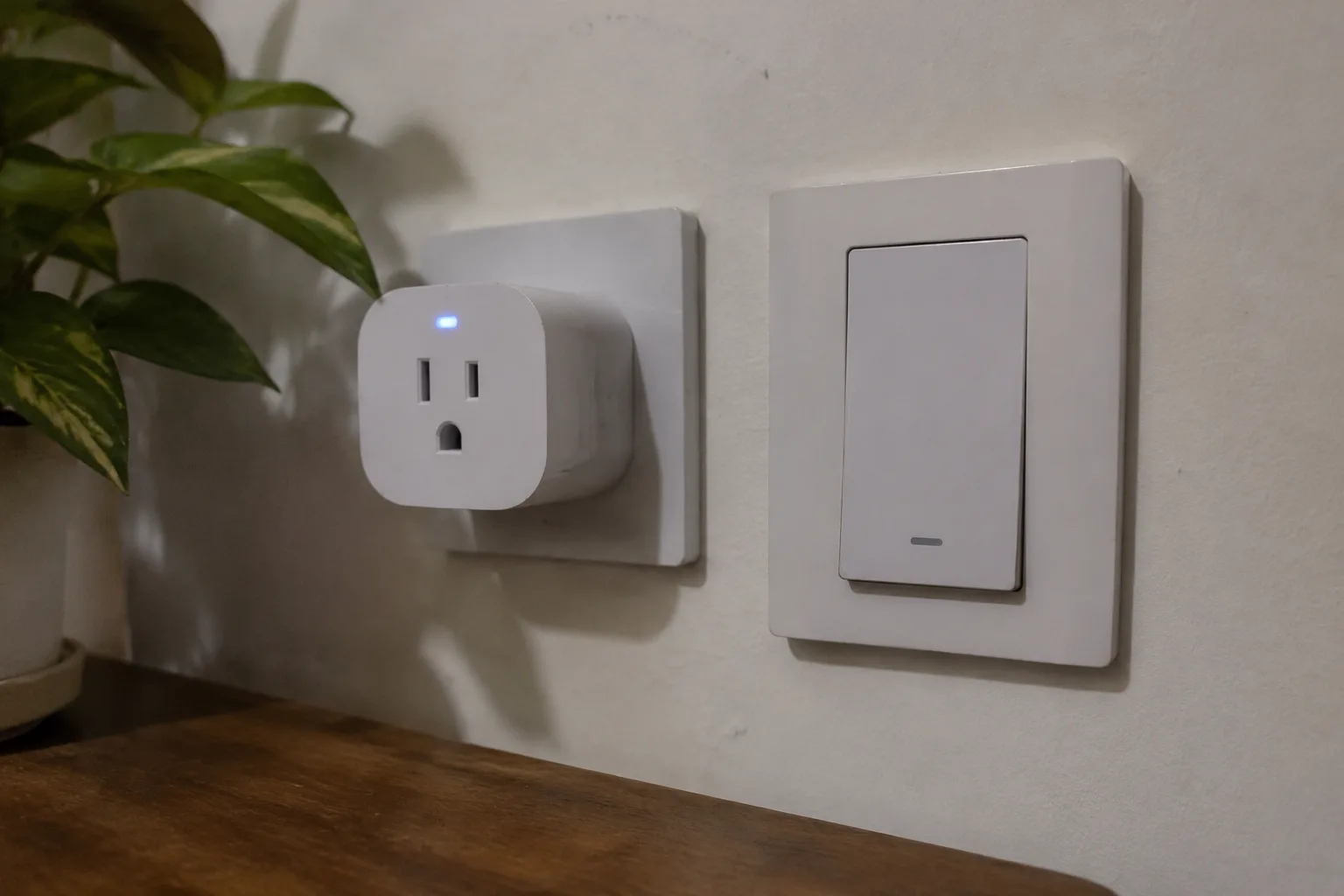
The two devices solve different problems. A smart plug sits between an outlet and whatever gets plugged into it, so it can only control things with a cord. A smart switch replaces the wall switch itself and controls whatever is wired to that circuit, which in most houses means the ceiling light, the bathroom fan, the porch fixture, the row of recessed cans over the kitchen island. Those are different jobs. The confusion comes from the fact that both get marketed as "make your home smart," a phrase that means nothing until it runs into the actual wiring of a particular room.
What a smart plug can and cannot reach
A smart plug is the least invasive smart home device ever sold. It goes into an existing outlet, the lamp or fan or coffee maker goes into it, and the whole installation takes about four seconds. No breaker, no screwdriver, no electrician, no landlord conversation. In a rental, that matters enormously. A tenant can add half a dozen smart plugs and remove every one of them at move-out without leaving a mark on the wall.
The limitation is physical. Whatever the plug controls must have a cord and must be plugged in at that specific outlet. Ceiling lights are out. Hardwired bathroom exhaust fans are out. The under-cabinet lighting that was wired directly into the wall is out. Doorbell chimes, garage door openers, and anything on a dedicated circuit are also out, at least without an electrician's help.
There is a second, quieter limit. A smart plug sits in the outlet, which means the outlet is occupied. In a room with four receptacles, giving one over to a plug that controls a single lamp is often a poor trade. The bulky ones can block the second socket entirely, and even the slim models take up the space where a phone charger used to live. Multiply that across a living room and the outlet situation gets annoying fast.
The wall switch is already in the right place
Every room with a ceiling light already has a switch on the wall by the door. That is the single strongest argument for replacing it rather than working around it. The switch is where hands go on the way into a dark room, and no amount of app design has beaten the physical toggle for that job.
A smart switch keeps that gesture and adds to it. It still works as a switch. It also works from a phone, from a voice assistant, from a schedule, and from an automation that fires when the sun sets. The ceiling light in the hallway, the porch light that should come on at dusk, the bathroom fan that should run for twenty minutes after a shower, all of these become controllable without a single plug entering the picture.
The catch is installation. A smart switch requires turning off the breaker, pulling the old switch out of the box, and dealing with wires. In newer homes with a neutral wire present in the switch box, the job takes a confident DIYer maybe twenty minutes. In older homes, the neutral is often missing, and the options narrow to specific no-neutral models that cost more and work less reliably with dimming LEDs. A house built before the 1980s should be treated as a question mark until someone looks inside the box.
The lamp in the corner is not a wiring problem
Most living rooms have a floor lamp or a table lamp that is the actual light source people use in the evening. Ceiling lights are for cleaning and finding things. The lamp is for living. That lamp has a cord, which makes it a smart plug job from the start, and no smart switch will touch it unless the lamp happens to be plugged into a switched outlet, which is a feature of some older homes and not most.
This is where the two devices stop being rivals and start being a pair. The plug handles the lamp. The switch handles the ceiling. A house that wants both to work on a schedule needs both devices, and trying to force one to do the other's job produces the awkward workarounds: a smart plug dangling from a switched outlet that has to be left permanently on, or a smart switch installed in a room where the only light worth controlling is plugged into the wall.
The switched outlet deserves a warning. Plenty of homes have outlets tied to a wall switch, and the temptation is to put a smart plug there and call it done. It works until someone flips the wall switch off, cutting power to the smart plug and dropping it off the network. The plug comes back when the switch comes back, but the schedule and the automation state do not always survive that cleanly. A smart plug belongs in an always-on outlet.
Where the price comparison actually lands
Smart plugs are cheap. A basic Wi-Fi plug costs less than a takeout dinner, and a four-pack often costs less than a single smart switch from a reputable brand. That price gap is real and it drives most of the decisions in this category.
The comparison shifts once the switch replaces something that already exists. A smart switch is not an add-on device sitting in an outlet; it is the switch, upgraded. The wall already has a switch in it. The cost is the difference between the switch that is there and the switch that could be there, and the old one gets thrown away. A smart plug, by contrast, adds a device to a room that did not have one, occupies an outlet, and controls exactly one corded thing.
For a renter, none of that math matters because the switch is not an option. For a homeowner planning to stay, the switch is usually the better spend in any room where the ceiling light is the main light. The plug wins in every room where the light has a cord, which is most bedrooms, most living rooms, and every corner where a lamp does the actual work.
Three-way switches and dimming raise the stakes
Halls, stairways, and large rooms often have two switches controlling the same light. Smart switches exist for these three-way setups, but the wiring is fussier, the instructions are longer, and the failure modes are more expensive. A person who is not comfortable identifying a traveler wire should hire someone. A smart plug sidesteps the entire problem because it never touches the circuit.
Dimming splits the same way. Smart dimmer switches control the ceiling fixture and are excellent at it, with smooth ramps and scenes that set a room to a specific warmth. Smart plugs generally do not dim, and the ones that claim to handle dimmable lamps often produce a faint buzz or a flicker at low levels that no amount of app calibration fully removes. The reliable pattern is a dimmer switch for the ceiling and a plain on-off plug for the lamp, with the lamp's own dimmer, if it has one, left alone.
Appliances that should never go on a smart switch
There is a category of device that belongs on neither a smart switch nor a cheap smart plug, and it deserves its own mention because the mistake is common and occasionally serious. Space heaters, irons, hair tools, and anything that generates heat unattended should not be scheduled to turn on while the house is empty. The plug can switch the power. It cannot see the sweater draped over the heater.
Coffee makers, slow cookers, and window air conditioners sit in a middle zone. They work fine on a smart plug rated for the load, and the convenience is genuine. The load rating is the thing to check, printed on the plug and on the appliance, and a plug that is warm to the touch after an hour of running a heater or a big appliance is a plug that is being asked to do too much. Smart switches carry their own load limits too, and a switch controlling a large fixture or a motor should be checked against them.
Protocol and hub questions apply to both
Both devices come in Wi-Fi, Zigbee, Z-Wave, and Matter variants, and the choice matters more than the form factor. Wi-Fi devices connect directly and need no hub, which is the simplest path for a small setup. Zigbee and Z-Wave devices need a hub but tend to be more responsive and less crowded on the network once a house has more than a dozen smart devices. Matter is the newer standard designed to make all of this interoperable, and it is improving, but the experience still varies by brand and by which ecosystem is doing the controlling.
The practical advice is to pick a protocol before buying the first device, because a house that ends up with three incompatible apps and two hubs is a house where nobody uses the automations. The form factor decision, plug or switch, is easier to change later than the protocol decision. Swapping a plug is a four-second job. Rebuilding a smart home around a different standard is a weekend.
A room-by-room way to settle it
The fastest way to decide is to walk through the house and ask one question at each light: does it have a cord or is it wired in. Corded lights get a smart plug in the nearest always-on outlet. Wired lights get a smart switch, assuming the wiring supports one and the person doing the work is comfortable with the box. Bathroom fans, porch lights, and hallway fixtures fall on the switch side by default because there is no cord to plug in.
Rooms that need both get both. A living room with a ceiling fixture and two lamps wants a switch for the ceiling and a plug for the lamps, and the automations can group them so a single command dims the room for a movie. A bedroom with a single table lamp and no ceiling light needs one plug and nothing else. A kitchen with a dozen recessed cans and no lamps needs switches, possibly several, and no plugs at all.
The mistake to avoid is buying a pile of one device and then discovering the house needed the other. A starter kit of smart plugs is a fine way to test whether the household actually uses schedules and voice control before committing to the wiring work of switches. Once the habit sticks, the switches go in where the ceiling lights are, and the plugs stay where the lamps are, each doing the job the other cannot.