The smart plug aisle has become a strange place. Shelves that once held a single boring white cube now carry devices with energy monitoring, matter logos, schedules, sunrise simulations, and apps that want an account before the lamp will turn on. Most of it is noise. A plug has one job: sit between the wall and a dumb appliance and make that appliance obey a phone. Everything else is a feature someone in marketing needed to justify a price bump.
For lamps and small appliances specifically, the calculus is narrower than for, say, a washing machine or a space heater. A lamp draws a few watts and gets switched a few times a day. A coffee maker pulls a thousand watts for four minutes. A fan runs for hours at low draw. These loads are gentle, they are predictable, and they are exactly the kind of thing a cheap plug handles without complaint. The money spent above the baseline buys convenience and reliability, and it is worth being clear about which is which.
The plug that disappears is the one worth buying
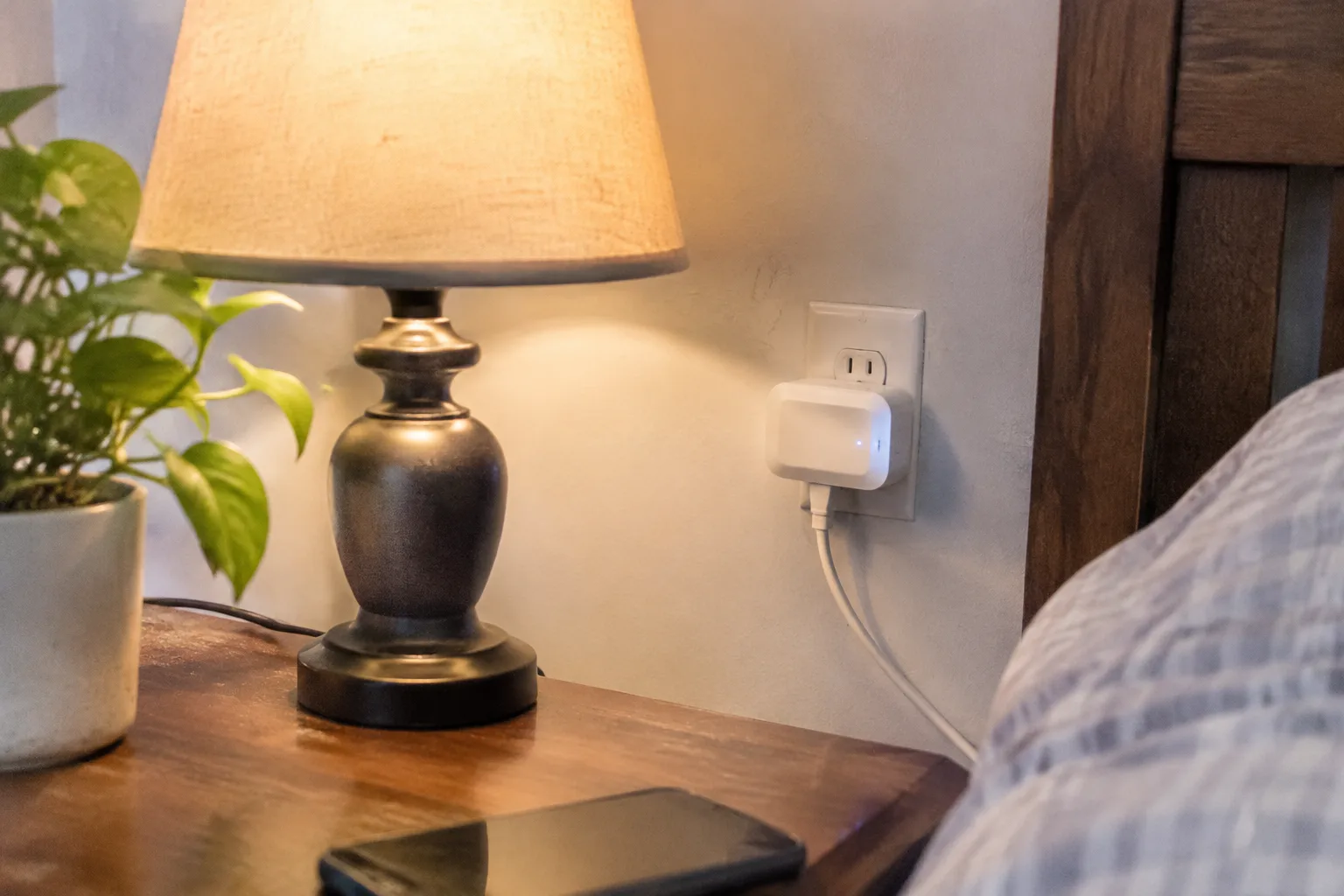
The best smart plug for a bedside lamp is the one that never announces itself. It pairs in under a minute, holds its schedule through a router reboot, and has an app that opens to a switch instead of a dashboard. That last part matters more than any spec sheet admits. A person reaching for a lamp at 11 p.m. does not want to navigate a home screen with three tabs and a promotional banner for a premium tier.
This is where the budget tier and the premium tier split in ways that are not obvious from the box. A twelve-dollar plug and a thirty-dollar plug both turn on a lamp. The cheap one tends to fail at the edges: the schedule drifts after a power cut, the app logs out, the Wi-Fi chip struggles with a mesh network that hands off between nodes. The expensive one usually fails less, but it also tends to bundle features nobody asked for.
The honest recommendation for most lamps is a mid-priced plug from a brand that has been making them for several years and still updates the app. Reliability compounds. A plug that works every time for three years is worth more than a cheaper one that needs re-pairing twice a year.
Matter changed the math, slowly
The Matter standard was supposed to end the era of five different apps for five different plugs. In practice it has done about half of that. A Matter-certified plug can be added to Apple Home, Google Home, Amazon Alexa, or SmartThings without the manufacturer's app at all, which is a genuine improvement for anyone who resents installing a third-party app for a device with one button.
The catch is that Matter onboarding is still fussier than the marketing implies. It needs a hub or a speaker that supports it, a 2.4 GHz network, and a phone with the right permissions enabled. When it works, it is clean. When it does not, the troubleshooting is worse than the old app-based setup because there are now two companies to blame instead of one.
For a lamp, Matter is a nice-to-have. For a household that already runs Apple Home or Google Home and wants one interface, it is worth paying a few dollars more. For a single plug controlling a reading light, the manufacturer's app is fine and often simpler.
Where energy monitoring earns its keep
Energy monitoring is the feature most often sold and least often used. A plug that reports wattage is genuinely useful for exactly one kind of small appliance: the one that runs unattended for long stretches and whose draw is not obvious. A space heater on a smart plug with monitoring will show a number that makes a person reconsider the schedule. A window air conditioner will do the same.
A lamp will show four to nine watts and then nothing interesting ever again. Paying extra for monitoring on a lamp plug is paying for a graph that gets checked once and forgotten. The same money is better spent on a plug with a more reliable schedule or a physical button that works without the app.
There is a real use case, though, for the person who wants to know what the coffee maker draws on standby or whether the modem closet is quietly eating twenty watts around the clock. For those loads, the monitoring pays for itself in curiosity alone.
The physical button is not a legacy feature
Plenty of smart plugs now ship without a physical button, or with one so small and flush that it requires a fingernail. This is a mistake. The button is the fallback when the Wi-Fi is down, when the phone is in another room, when a guest needs to turn on the lamp and has no idea how the house works.
A good plug has a button big enough to find by feel in the dark and firm enough that it does not trigger accidentally when a cable is nudged. It should toggle the relay directly, not send a command through the cloud. Some of the cheaper plugs route the button through the app, which means a dead internet connection makes the button useless. That is a design failure worth checking before purchase.
The same logic applies to the plug's footprint. A plug that blocks the second outlet in a duplex receptacle is a small daily annoyance that never goes away. Side-facing outlets and slim bodies solve this, and they are worth seeking out for a lamp behind a nightstand or a couch where space is tight.
Small appliances need a different check
Lamps are easy. Small appliances are where the smart plug category gets tested. The rule of thumb is simple: if the appliance has a mechanical switch that stays on when power is applied, a smart plug works. If it has a digital touch panel or a soft power button, the plug may only be able to cut power, not restore the appliance to a ready state.
A drip coffee maker with a physical rocker switch is a perfect candidate. A pod machine with a touch screen is not, because it will boot into standby and wait for a second press. A box fan with a rotary dial works beautifully. A tower fan with a remote and a display does not, because cutting power resets its settings every time.
Heaters deserve a specific warning. Many space heaters draw 1,500 watts, which is close to the 15-amp limit of a standard US circuit and well above what some cheap smart plugs are rated to switch continuously. A plug rated for 10 amps will handle a lamp forever and a space heater for a while, and then the relay contacts will pit and the plug will fail, sometimes dramatically. For any resistive heater, the plug should be rated at 15 amps and the circuit should not be shared with much else.
Schedules beat voice control every time
Voice control is the demo feature. Schedules are the feature that actually changes behavior. A lamp that comes on at 6:40 a.m. and off at 8:00 a.m., then on again at sunset, requires zero interaction and quietly does more for a daily routine than any amount of "hey, turn on the lamp."
The quality of the schedule engine is therefore a better buying signal than whether the plug works with three voice assistants. A good schedule survives a power outage, handles sunrise and sunset offsets, and allows different timings on weekends. A bad one forgets everything the moment the router reboots and has to be re-entered by hand.
Sunrise simulation, where the lamp ramps up gradually over twenty or thirty minutes, is a genuinely pleasant feature for a bedroom lamp and a genuinely useless one for a kitchen counter light. It is worth having on the plug that controls the lamp a person wakes up next to, and worth ignoring everywhere else.
What the extra money actually buys
The spread in this category runs from about eight dollars to about thirty-five. The cheap end buys a plug that works until it does not, usually within a year, usually in a way that requires a full reset and re-pair. The middle buys a plug from a company that has been shipping firmware updates for years and has a support page that is not a dead link. The top end buys a plug with a nicer app, better energy reporting, and sometimes a Thread radio for lower latency and better local control.
For a lamp, the middle is the right place to land. For a small appliance that runs on a schedule, the middle or slightly above is right. For a heater, buy the plug rated for the load and do not economize, because the failure mode is worse than a dead lamp.
The single most useful thing a buyer can do is check the plug's continuous rating and the appliance's actual draw before pairing anything. A lamp is four to nine watts. A fan is forty to sixty. A coffee maker is a thousand for a few minutes. A space heater is fifteen hundred for as long as it is on. Matching those numbers to the plug's rating is the whole game, and it takes about ninety seconds.
The plug on the nightstand, three years in
The test of a smart plug is not the first week. It is the third year, when the app has been updated eleven times, the original phone is gone, and the plug is still expected to turn on a lamp at sunset without being asked. The plugs that pass that test tend to be unglamorous: a small white cube, a physical button, a schedule that survived every router reboot, and a manufacturer that did not abandon the product line.
That is the plug worth buying for a lamp. The one that, three years from now, is still doing its one job and has never once needed a person to think about it.