A portable Bluetooth speaker for outdoor use is a study in compromises, and the compromise that matters most is rarely the one printed on the box. Wattage, driver size, frequency response: these are the numbers that sell speakers, and none of them survive contact with a windy afternoon at a campsite or a tailgate in a gravel lot. What survives is a smaller, stranger set of qualities, most of which are hard to quantify and easy to notice only after the return window has closed.
There is a reason outdoor speakers sound worse than indoor ones, and it has almost nothing to do with the speaker. Sound outdoors has no walls to bounce off, so every reflection that would normally reinforce a note is gone. The low end, which depends on room gain to feel present, evaporates. A speaker that sounds full and warm in a kitchen can turn thin and shouty the moment it sits on a picnic table, because the kitchen was doing half the work.
That single fact should reorganize the entire shopping process.
Loudness Is a Function of Headroom, Not Peak Watts
Every outdoor speaker will be pushed harder than its indoor counterpart. Wind, distance, and background noise all demand volume, and volume is where small speakers fall apart. A tiny driver can hit a loud peak for a fraction of a second, but sustained loud playback exposes the limits of both the driver and the amplifier.
The number that matters is not peak power but whether the speaker stays clean near its top end. A speaker that begins to compress and harden at seventy percent volume is effectively a quieter speaker than one that holds its composure at ninety. This is why two units with identical wattage ratings can behave completely differently on a beach. The honest test is to stand a few meters back in open air and listen for the moment the sound stops growing and starts straining.
The IP Rating Tells Less Than the Gasket Does
Ingress protection ratings have become a marketing surface, with IP67 and IP68 badges printed large. The rating is real and worth checking, but it describes a lab condition: fresh water, controlled depth, controlled duration. It says nothing about salt, sand, sunscreen, or the fine grit that works its way into a charging port over a summer.
A better indicator is physical construction. Look for a port cover with a real gasket and a satisfying snap, not a thin rubber flap that will curl after a month in a hot car. Look for a speaker whose grille is metal rather than fabric, because fabric holds moisture and grit and eventually smells like a damp gym bag. A rubberized housing that survives a drop from table height onto rock is worth more than an extra digit on the IP rating.
Battery Claims Assume a Volume Nobody Uses
Twenty-four hours of playback is a common claim, and it is usually measured at half volume in a mild room. Outdoors, at the volume an open space actually requires, that figure can fall by half or more. Cold weather takes another bite. A speaker rated for a full day may deliver four or five honest hours in the conditions it was bought for.
The practical move is to discount the stated battery life substantially and then check how the speaker charges. USB-C charging from a power bank extends a trip far more reliably than a bigger internal battery, because the bank can be swapped and the speaker can keep playing. A speaker with a sealed, non-replaceable battery and a proprietary charger is a paperweight the moment that charger is left at home.
Weight Matters More Than the Spec Sheet Admits
A speaker that lives on a patio can weigh whatever it likes. A speaker that gets carried to a river, a ridge, or a distant tailgate is cargo, and cargo is measured in the hand and the shoulder rather than in grams on a product page. The difference between 500 grams and a kilogram is trivial in a store and enormous at the end of a two-mile walk.
This is where most buyers overshoot. They buy for the loudest party they might host and then resent the weight on every ordinary outing. A smaller speaker with honest output and a strap that actually fits a carabiner will get used far more often than a heavy unit that stays in the trunk because it is a hassle to carry.
The Bluetooth Version Is the Least Interesting Spec
Bluetooth 5.3 versus 5.0 is close to irrelevant for outdoor listening. Range and stability matter, and both are more dependent on antenna placement and interference than on the version number. A speaker that drops out when a phone is in a back pocket and the speaker is ten meters away is a bad speaker regardless of its spec sheet.
What deserves attention instead is whether the speaker can pair with a second unit for stereo or party mode, and whether that pairing survives a phone call or a walk out of range. Multi-speaker pairing is the single most useful feature for outdoor use, because two modest speakers placed apart fill a space more evenly than one loud speaker placed in a corner, and they do it without the harshness that comes from pushing a single unit too hard.
A Tether Point Is Not a Gimmick
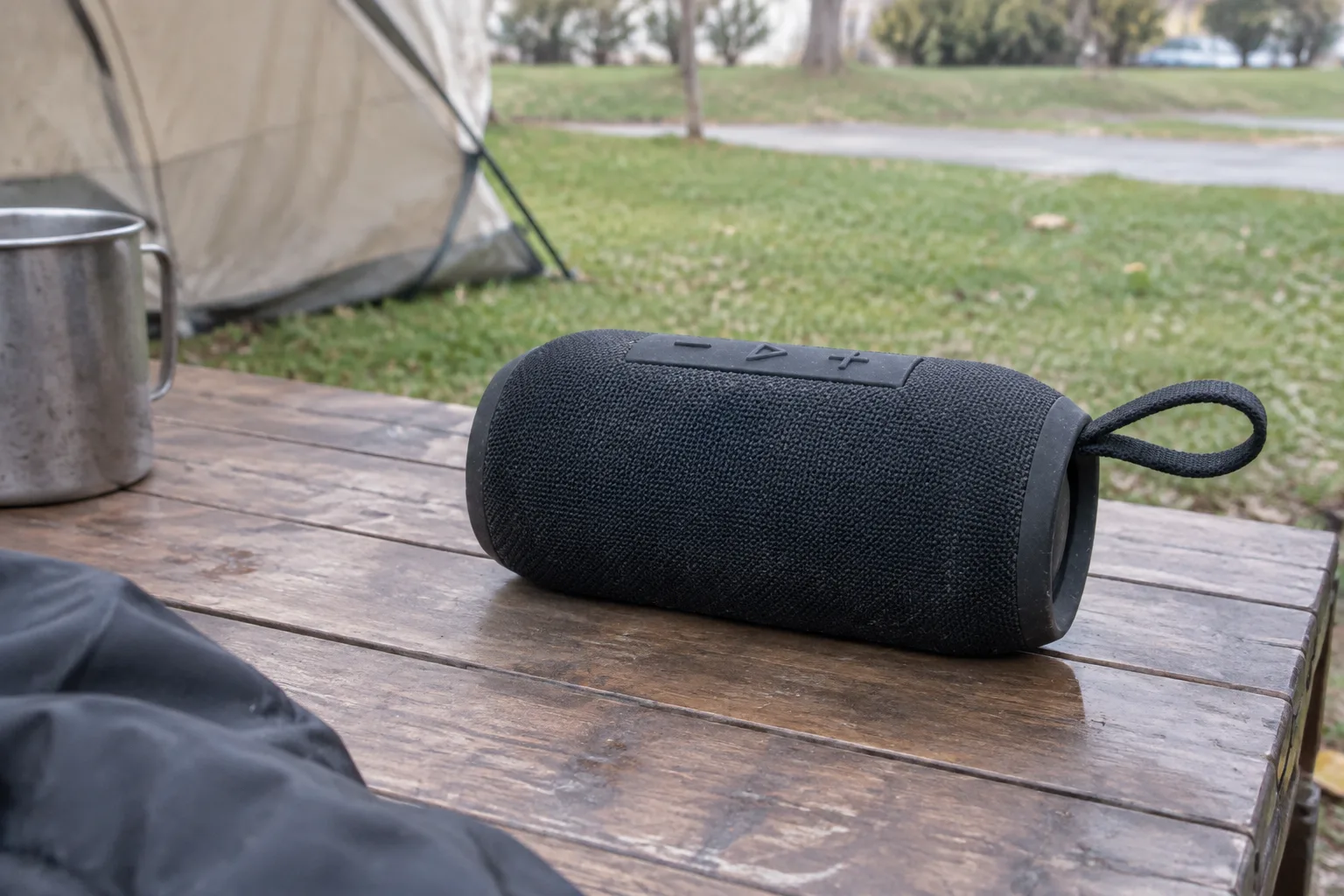
Outdoor speakers get dropped, knocked off tables, and set down on uneven ground. A molded loop or a metal attachment point for a strap is the difference between a speaker that survives a season and one that ends up in a lake. It is a small feature, easy to overlook in a showroom, and the first thing missed when it is absent.
The same logic applies to the base. A speaker with a flat, grippy bottom stays put on a picnic table or a rock ledge. A speaker with a rounded or glossy base slides at the first nudge. These are physical details that no spec sheet captures and that a person only notices after a speaker has taken its first tumble.
The Speaker That Gets Taken Outside Is the One With No Fuss
The best outdoor speaker is not the loudest or the most rugged or the one with the longest battery claim. It is the one that gets grabbed on the way out the door without a second thought, because it charges with the same cable as everything else, because it fits in a bag without a dedicated case, and because it survives being set down on dirt without a ritual cleaning.
A friend's speaker lives in a canvas tote by the back door, and it has been to more beaches than most people's dedicated gear. It is not impressive on paper. It is small, it is scuffed, and the rubber port cover has a permanent crease. It also has never once failed to play, which is a longer track record than most of the expensive units that got bought for a single party and then retired to a shelf.
That is the real test. A speaker earns its place outdoors by being boring to own and reliable to use, and the spec sheet rarely captures either quality.