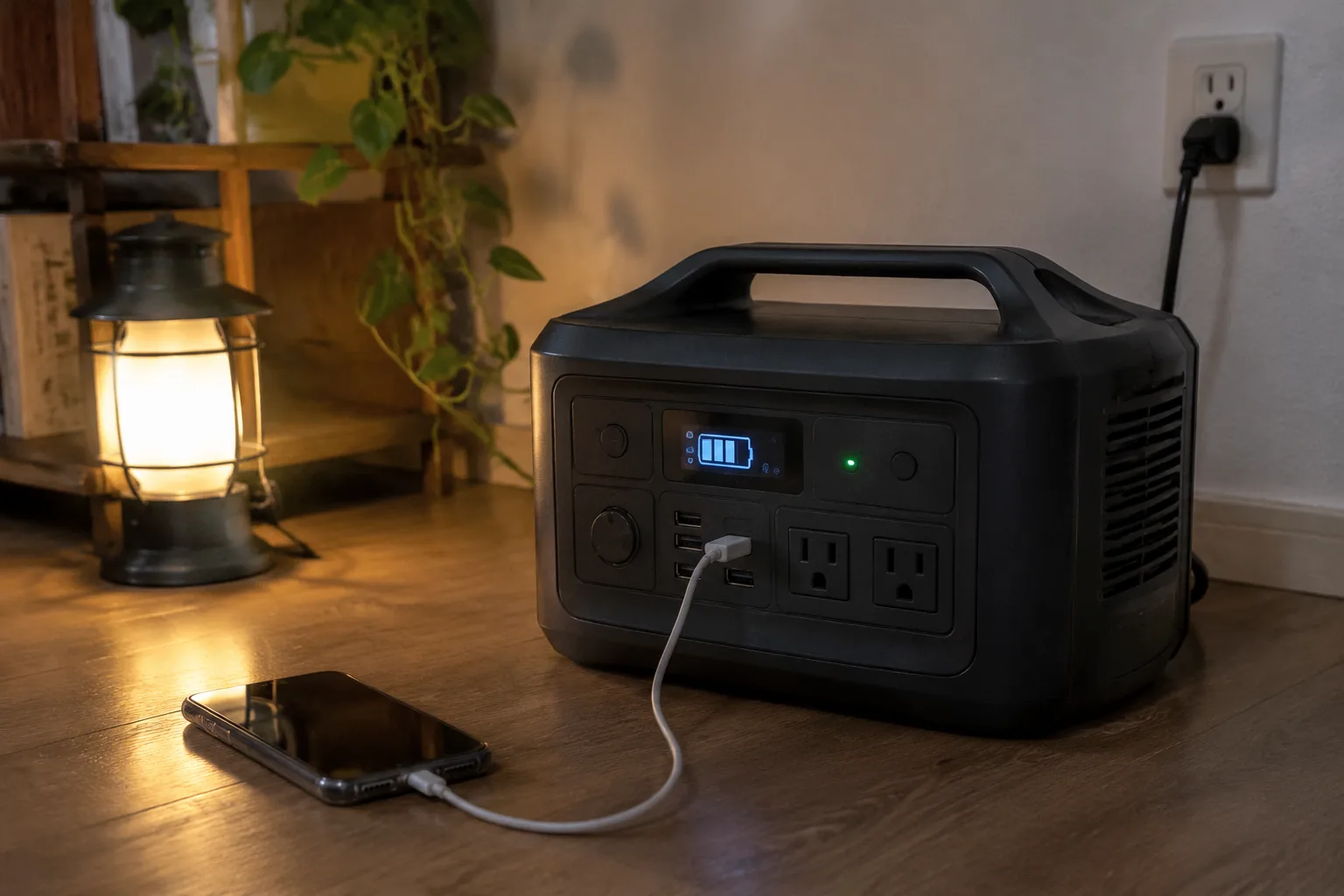
A portable power station is a battery in a box with an inverter bolted on, and the entire home-backup question comes down to which box and how big. That sounds dismissive. It is meant to be clarifying. The product category has swollen with camping-friendly marketing language, app integrations, and glossy photos of van life, while the thing a household actually needs during an outage is embarrassingly simple: enough stored watt-hours to carry a refrigerator, a furnace fan, a few lights, and a router until the grid returns or the sun does.
Most buyers get this wrong in the same direction. They buy too little capacity, then discover the refrigerator compressor's startup surge trips the unit within the first hour. Or they buy too much, spending four figures on a 3,000-watt-hour brick that takes nine hours to charge and weighs as much as a bag of concrete.
The useful skill is sizing, and sizing is arithmetic, not vibes.
Watt-hours tell the truth; watts only tell half of it
Every unit advertises two numbers, and they answer different questions. Watt-hours (Wh) measure storage: how much energy the battery holds. Running watts measure output: how much it can push out at once. A unit with 1,000 Wh and 1,000 watts can run a 1,000-watt device for roughly an hour, assuming perfect efficiency, which never happens.
Inverters waste energy as heat. Expect to lose somewhere around 10 to 15 percent converting stored DC power into the AC that household appliances expect. A 1,000 Wh battery realistically delivers 850 to 900 Wh to a plugged-in load.
Then there is surge. Motors draw a hard spike at startup, sometimes two to three times their running wattage for a fraction of a second. A refrigerator rated at 150 running watts might pull 400 to 600 watts for a heartbeat when the compressor kicks on. A sump pump can be worse. Any station considered for home backup needs a surge rating that clears those spikes with room to spare.
The four appliances that decide the sizing
Whole-house backup is a generator's job. A portable station is a critical-load device, and the critical load in most homes is short and unglamorous.
A refrigerator is the anchor. Modern units run around 100 to 200 watts and cycle on and off, so daily consumption lands near 1 to 2 kilowatt-hours. A chest freezer is similar. Keeping food cold for a day costs a mid-size station a large share of its capacity, but it is the load most households care about most.
Furnace fans matter more than people expect. A gas furnace still needs electricity for the blower and control board, typically 300 to 800 watts while running. In a winter outage, that is the difference between a cold house and a dangerous one.
Then the small stuff that adds up quietly: a router and modem (10 to 20 watts), a few LED lamps (under 10 watts each), a phone charger, a laptop. A CPAP machine belongs on the list for anyone who uses one. Medical devices deserve their own line in the calculation, with the manufacturer's stated draw rather than a guess.
Sum the running watts, note the surge for anything with a motor, and multiply the expected hours by the wattage. That figure, padded by the inverter loss, is the minimum capacity. One day of refrigerator plus furnace plus small electronics usually lands between 1,500 and 2,500 Wh.
Lithium iron phosphate has quietly won
Battery chemistry is the one spec worth caring about beyond the numbers on the front of the box. Most serious stations now use lithium iron phosphate (LiFePO4). The older alternative, nickel manganese cobalt or plain lithium-ion, stores more energy per pound but degrades faster and carries more thermal risk.
LiFePO4 cells typically hold up for several thousand charge cycles before dropping to 80 percent of original capacity. A station that sees a handful of outages a year, plus occasional camping trips, will outlast its owner's patience with the technology. That longevity is why nearly every brand at the mid and upper end of the market has moved to it, and why the older chemistry now looks like a discount aisle.
The practical consequence: a LiFePO4 station bought for backup should still be usable a decade from now, provided it is stored properly. Which leads to a detail almost nobody mentions at purchase.
A battery in a garage for two years is a battery half gone
Lithium batteries self-discharge and dislike sitting at full charge or at zero. Left plugged in at 100 percent for months, capacity fades. Left dead for months, some units refuse to wake up at all. Manufacturers usually recommend storing around 50 to 60 percent charge and topping it up every few months.
This matters because home backup is a use case defined by neglect. The station sits in a closet until the night the lights go out, which is precisely the worst pattern for the battery inside. A unit bought and forgotten may deliver half its rated capacity on the one evening it is needed.
There is also cold. Charging a lithium battery below freezing can damage it permanently, and many stations refuse to accept a charge in low temperatures to protect themselves. A garage in a northern winter is a bad home for one of these. A conditioned closet is a better one.
Recharge speed is the spec that decides an outage
Capacity without a way to refill it is a countdown timer. A station that takes eight hours to charge from a wall outlet is fine during a short outage, since the grid usually returns before the battery empties. In a multi-day event, the wall outlet is gone and the refill options are solar panels or a car.
Solar input deserves scrutiny. A station might accept 200 watts of panel input, but the panels themselves are sold separately and cost real money. Cloud cover, panel angle, and winter sun cut that figure hard. A realistic solar setup might return 400 to 800 Wh on a decent day, which extends an outage by hours, not days. Anyone expecting to run a household indefinitely on a folding panel and a battery is going to be disappointed by the second morning.
Car charging through a 12-volt outlet is slow, often under 100 watts, and useful mainly as a trickle. Some stations support faster charging from a vehicle's higher-output circuit, but that requires an installed setup, not a cigarette lighter.
Output ports, transfer switches, and the plug that does not exist
Household wiring is where portable stations hit a wall. Plugging a refrigerator into a station's AC outlet works. Powering the house's built-in circuits does not, at least not without help. The typical workaround is an extension cord run from the station to the appliance, which is fine for a fridge and a lamp and miserable for a furnace in a basement.
A transfer switch or a dedicated inlet box, installed by an electrician, allows selected circuits to be fed from a station's output. That installation costs money and adds a step most buyers skip. The stations that support this are usually the larger, heavier models with 30-amp outlets, and the pairing is worth planning before the outage rather than during it.
Smaller details matter too. USB-C ports with power delivery handle laptops and phones efficiently. A 12-volt car socket runs a portable fridge or an inflatable mattress pump. Pure sine wave output keeps sensitive electronics and furnace control boards happy; modified sine wave, still found on cheap units, can cause motors to hum and electronics to misbehave.
Weight is a spec, and it is the one that gets ignored
A 2,000 Wh LiFePO4 station weighs somewhere around 50 to 70 pounds. A 3,000 Wh unit can push past 90. That is fine for a unit that lives in a closet and gets wheeled out twice a year. It is not fine for a unit intended to travel to a campsite, up a flight of stairs, or into a car trunk by one person.
The honest framing: capacity and portability pull in opposite directions, and the buyer has to decide which one the household actually needs. A backup-first purchase should favor capacity. A camping-first purchase should favor weight and accept a smaller battery. Trying to satisfy both usually produces a unit that is too heavy to carry and too small to run a furnace.
What a sensible purchase looks like for a typical house
For a household that wants to keep a refrigerator, a furnace fan, lights, and a router alive for a day, a LiFePO4 station in the 1,500 to 2,500 Wh range with at least 1,800 running watts and a surge rating above 3,000 watts covers the load. Pure sine wave output, a 30-amp outlet for future transfer-switch wiring, and solar input of 400 watts or more round out the useful spec sheet.
That unit will weigh 40 to 60 pounds and cost somewhere in the low four figures. It will sit in a closet most of the year. It will need a reminder on the calendar to charge to half every few months.
And on the night the grid fails, when the refrigerator hums back to life and the furnace ignites and the router blinks on, none of the marketing copy about van life will matter. The arithmetic will.