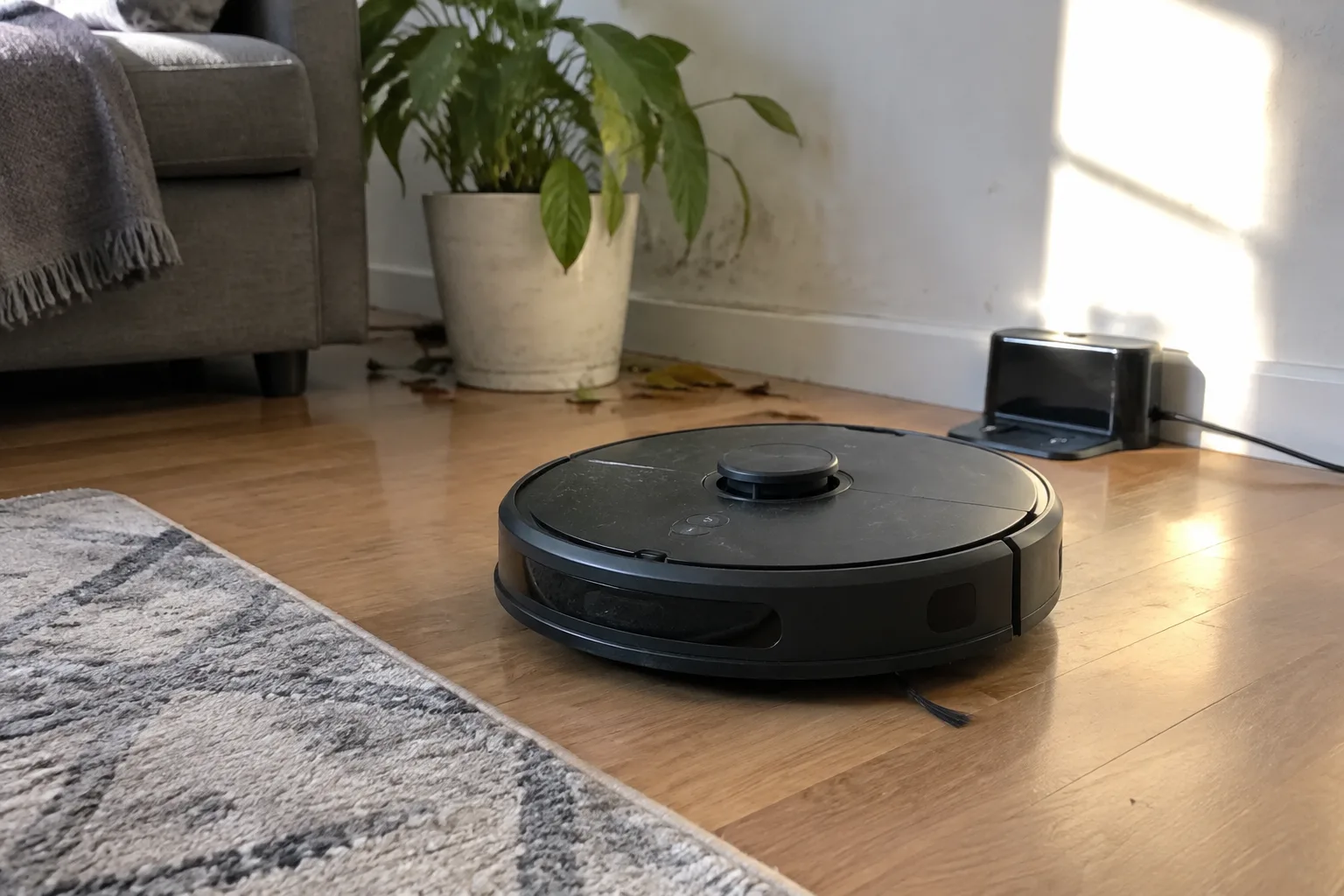
The first robot vacuum sold in serious numbers did not navigate. It bounced. It caromed off chair legs and baseboards at random angles, and a household could track its progress through the house by the sound of small plastic collisions. That was around twenty years ago. The machines on shelves now carry lidar, cameras, mapping software, and enough onboard compute to plan a route through a three-bedroom house. The technology improved enormously. The buying experience did not. A first-time buyer walks into a store or opens a product page and faces forty models with names built from model numbers, all of them claiming to do the same thing.
Most of the mistakes made in that moment are not about bad products. They are about mismatches. A perfectly good vacuum goes into a home that needed a different kind of perfectly good vacuum, and the buyer concludes robot vacuums are useless. The five mistakes below tend to be the expensive ones.
Buying for the Cleanest Floor in the House Instead of the Messiest One
Shopping starts with the spec sheet, and the spec sheet rewards the ideal case. Suction measured in pascals. Battery life under lab conditions. A runtime figure that assumes bare floor and a machine that has never met a rug.
The real question is what the floor is actually covered in. A house with wall-to-wall low-pile carpet and one shedding dog has a different problem than an apartment with hardwood and a cat that tracks litter. The first needs brushroll agitation and decent pickup on fibers. The second needs strong edge cleaning along baseboards and something that can handle scattered granules without flinging them across the room.
A buyer who reads ten spec sheets and picks the highest suction number has learned almost nothing about which machine handles pet hair without tangling. Hair wrap is the quiet killer. Long human hair and pet fur wind around a brushroll in a tight spiral, and within a few weeks the machine is dragging a felted sleeve across the floor instead of sweeping it. Some models now use rubber fins or a comb-and-cutter design to reduce this. That feature matters more in a house with a golden retriever than any suction figure printed in a comparison table.
The practical move is to inventory the mess before reading a single review. Where does the debris come from? Which room is worst? Is there a threshold between the kitchen and the hall that a low-clearance machine will high-center on? Those answers narrow the field faster than any ranking list.
Assuming the Machine Will Map a House It Cannot See Into
Mapping is the feature that separates a modern robot vacuum from the bouncing hockey puck of two decades ago, and it is also the feature most often misunderstood at purchase.
Lidar works by spinning a laser and timing the return. It builds a precise floor plan of walls and furniture edges, in the dark, quickly. Cameras read visual landmarks and can recognize obstacles a laser might skim past: a cable, a sock, a small toy. Both systems need the robot to travel the space to learn it, usually over two or three full cleaning runs. The first run through a new house is exploratory and slow, and a buyer who expects a perfect map on day one will think the machine is broken.
The mistake is assuming mapping solves clutter. It does not. A floor plan tells the robot where walls are. It does not reliably tell it that a phone charging cable is a trap. Cables, shoelaces, and the fringed edge of a rug are the classic failure cases: the machine ingests them, the brush stalls, and the run ends with the robot stopped and beeping under a sofa. Cameras with object recognition help here. Lidar alone usually does not.
There is a second assumption buried in mapping: that the map stays accurate. Furniture moves. A chair gets pushed to a new spot. A door that was closed during setup is open the next week. A good machine re-maps and adapts. A cheap one cleans the same forty square feet twice because it still believes the couch is where it was last month.
Ignoring the Maintenance Calendar Hidden Inside the Price
A robot vacuum is not a purchase. It is the beginning of a subscription that does not send invoices.
Filters clog and need replacing every few months. Brushrolls wear down or get chewed up by hair and need swapping. Side brushes fray and lose their sweep. Some models use disposable dust bags inside the base station, and those bags are a small recurring cost that adds up over a year. None of this is hidden, exactly, but it lives in the manual rather than the product page.
There is also the labor the buyer did not budget for. The dustbin needs emptying after most runs in a home with pets. The brushroll needs cutting free of hair every week or two. The sensors on the bumper and underside need wiping so the machine does not start refusing to dock. A self-emptying base station reduces the first chore but adds a bag cost and a large plastic tower that has to live somewhere in the house.
This is where first-time buyers get quietly discouraged. The machine works for a month, then starts leaving a trail of dust because the filter is saturated, and the owner concludes the whole category is overhyped. A ten-minute maintenance routine every couple of weeks keeps most machines performing close to new. The buyers who plan for that routine stay happy. The ones who expect an appliance that needs nothing do not.
Overestimating What an Obstacle Course of Cables and Socks Allows
Every robot vacuum review includes the same caveat somewhere near the bottom: the machine works best in a tidy home. This is not a marketing dodge. It is the single biggest predictor of whether the owner will end up using the thing daily or leaving it in a closet.
Consider the floor of a normal living room on a Tuesday. A laptop charger snakes across the rug. A pair of shoes sits half off the mat. There is a tote bag with a strap pooling on the hardwood. A robot vacuum with good object avoidance will thread through some of this. A cheap one will find the strap. The difference between a machine that finishes a run and one that stops dead with a shoelace wrapped around its axle is often just the presence of a camera and the software trained to recognize a cable.
Buyers who plan to run the vacuum while at work should think hard about the state of the floor when they leave. If picking up cables and stray clothing before every run sounds like more work than vacuuming by hand, the robot will not earn its keep. The machines that handle clutter best cost more, and even they have limits. A fringed rug edge, a curtain hem that brushes the floor, a pet bowl with a raised lip: these are the small traps that end runs.
Treating Runtime and Noise as Afterthoughts Until the First Night
Two specs get ignored in the showroom and dominate daily life afterward.
The first is battery. A machine rated at ninety minutes of runtime is rated on bare floor at low power. Crank it to maximum suction to actually lift pet hair out of a rug, and that number can halve. A large house may need two runs, or a machine that returns to its dock to recharge and resume. That resume feature is worth checking. Without it, a half-charged machine stops somewhere in the hallway and the cleaning is simply unfinished.
The second is noise. Spec sheets list decibels in a way that makes every model sound tolerable. In a small apartment, a robot vacuum on high suction is loud enough to make a phone call difficult and a nap impossible. The practical schedule shifts to times when nobody is home, which is fine for some households and a real constraint for anyone working from a kitchen table.
Neither number tells the whole story, but both deserve a place in the decision. A quieter machine with slightly less suction may get run every day, and a vacuum that runs every day cleans better than a more powerful one that gets switched on twice a month because the noise is unbearable.
The Store Aisle Test That Beats Every Comparison Chart
There is a way to cut through the spec-sheet fog that does not require reading a single review. It requires standing in the room the machine will clean and answering one question: what is on this floor right now, and what will it take to get it off?
If the answer is mostly crumbs and dust on hard floor, a mid-range machine with a decent edge brush and a modest dustbin will do the job, and the extra money spent on lidar and object recognition buys convenience more than cleaning. If the answer is pet hair ground into carpet, the priorities shift to brushroll design, agitation, and a filter that does not clog. If the answer is a floor covered in cables and children's toys, the budget has to include obstacle avoidance, or the machine will spend more time stuck than cleaning.
The buyers who end up happiest with their first robot vacuum are rarely the ones who bought the most expensive model. They are the ones who matched the machine to the mess in front of them, budgeted for the filters and brushrolls, and accepted that the thing needs a little help from the humans it lives with. The bouncing puck of twenty years ago at least made its limitations obvious. The modern machine looks so capable that its limits are easy to forget until the first cable wraps around the axle.