Inside a power strip there is a small component called a metal oxide varistor, and it costs about as much as a decent cup of coffee. Its job is to clamp down on voltage spikes before they reach the devices plugged into it. The strip itself is cheap plastic and stamped copper. Most of what a buyer pays for at the register is the varistor, a fuse, a circuit breaker, and the marketing on the box. Understanding that ratio is the whole game when deciding whether a home office needs surge protection at all, and if so, how much.
Surge protectors are one of the few product categories where the price floor is genuinely generous. A strip that sells for twenty dollars often contains nearly the same protection circuitry as one selling for eighty. The difference sits in the joule rating, the clamping voltage, the number of outlets, the length of the cord, and whether the manufacturer bothered to get it tested by Underwriters Laboratories. The circuitry inside is boring. The rating printed on the package is where the honest information lives.
What a surge protector actually stops, and what it ignores
A surge protector is built to absorb brief overvoltage events: a few thousand volts arriving in microseconds and leaving just as fast. Nearby lightning is the dramatic case. More common are the smaller jolts that happen when a compressor motor kicks on, when the utility switches grids, or when a heavy appliance on the same circuit cycles. These are small enough to be invisible and frequent enough to matter over a decade of use.
The category that gets ignored is the sustained low-voltage sag, the brownout, the wiring fault, the reversed polarity, the missing ground. A typical surge strip does nothing about any of those. It cannot fix a circuit that was never grounded correctly in the first place. It cannot correct the wiring in an old house where the outlet tester shows an open neutral. It cannot rescue equipment from a power supply that is slowly cooking itself because the voltage coming in is consistently low.
The distinction matters for a home office because the failures people actually experience are usually not lightning. They are the slow degradation of a monitor's power board, a router that reboots whenever the air conditioner starts, a laptop charger that runs hot. A surge protector addresses only a slice of that list.
The joule number and what the package does not say
Joules measure energy absorption. A strip rated at 500 joules can absorb a certain amount of spike energy before its varistor degrades and eventually fails. A strip rated at 3,000 joules can absorb more. The number is useful as a rough comparison between strips from the same manufacturer, and it is nearly useless as an absolute measure because there is no standard test that forces every brand to rate it the same way.
Clamping voltage is the more honest specification. It tells the buyer at what voltage the strip starts shunting excess energy to ground. A lower clamping voltage is better, within reason. A strip that clamps at 330 volts is doing more useful work than one clamping at 500 volts. The number is printed on better packaging and omitted from worse packaging. That omission is a signal.
The UL 1449 rating is the piece of paper that separates tested strips from decorative ones. Underwriters Laboratories tests surge protective devices against a standard, and a strip carrying the UL 1449 mark has been through a defined regime. Strips without it may still work, but the buyer is trusting the manufacturer's own claims rather than a third party's. For a home office with a few thousand dollars of equipment on the desk, that mark is worth seeking out.
The desk setup that makes a surge strip worth buying
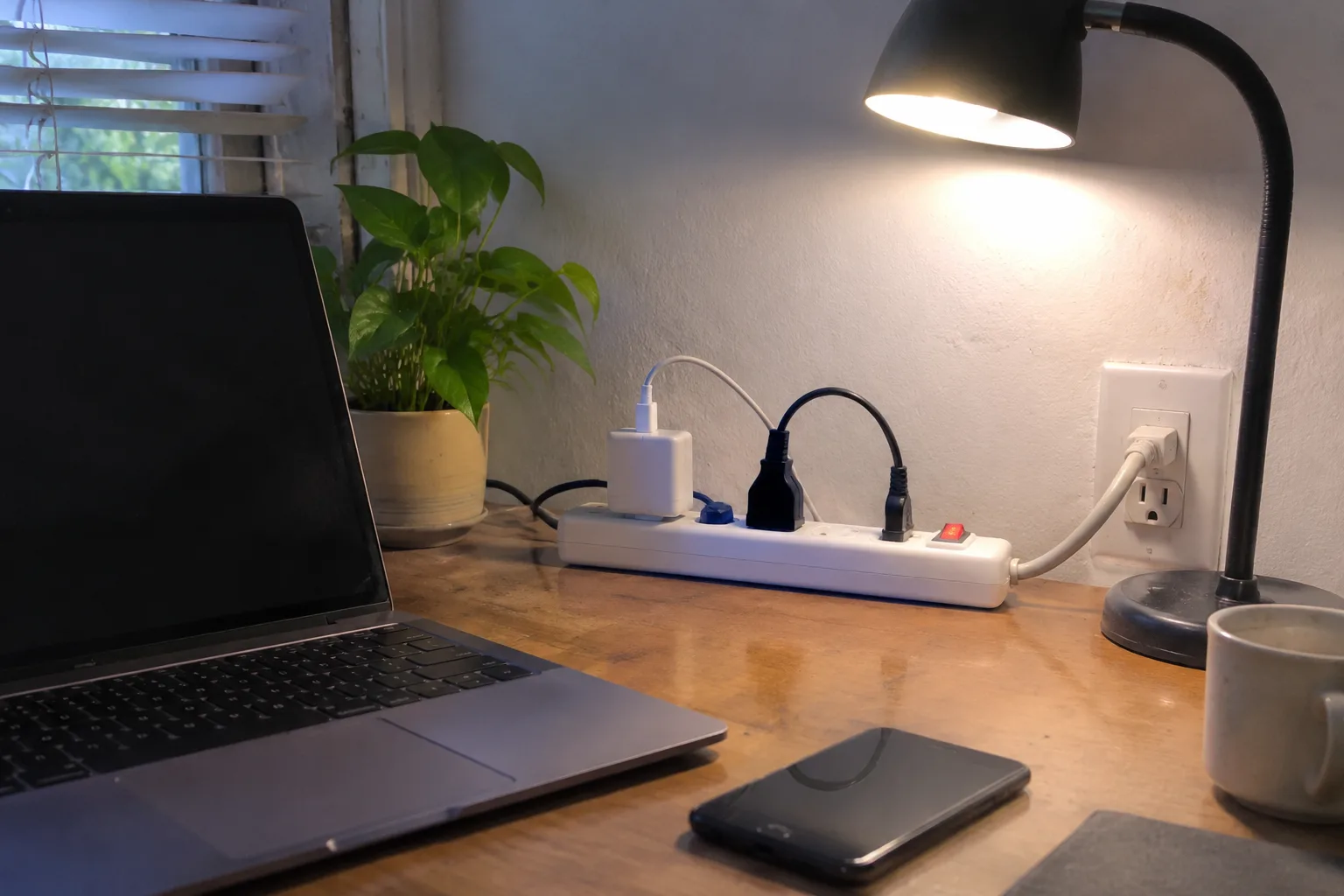
A home office usually holds a computer, one or two monitors, a router, a modem, a printer, a desk lamp, a phone charger, and a tangle of USB bricks. The total replacement cost of that pile sits somewhere between two thousand and six thousand dollars for a typical setup, more if the machine is a workstation or a design rig. A fifty-dollar surge strip protecting that pile is a rounding error against the replacement bill.
The math changes for the renter in a newer building with modern wiring and a whole-building surge suppressor at the panel. In that case the strip is redundant insurance. It still costs little, and it still does no harm, but the marginal benefit is small. The math also changes for the person in a hundred-year-old house with knob-and-tube remnants and a window air conditioner on the same circuit as the desk. There the strip is close to mandatory.
A useful rule of thumb: if the desk shares a circuit with a motor, a compressor, or a space heater, buy the strip. If the building is old, buy the strip. If the equipment on the desk is expensive and the power has ever flickered during a storm, buy the strip. If none of those apply, the strip is a modest convenience rather than a necessity, and the money is better spent on a decent outlet tester first.
Why the outlet tester should come before the strip
A ten-dollar outlet tester with three indicator lights reveals more about a home office's electrical reality than any surge strip. It shows whether the ground is connected, whether the hot and neutral are reversed, and whether the circuit is wired correctly at all. A surge protector relies on a functioning ground path to shunt excess energy safely. Plugging an expensive strip into an outlet with an open ground is like installing a good lock on a door with no frame.
Many older homes have ungrounded outlets, especially in rooms that were added or remodeled before the 1960s. A two-prong outlet with a cheater plug adapter is a sign the ground path may not exist. In that situation a surge strip offers a false sense of protection. The correct fix is an electrician, or at minimum a GFCI outlet, and the strip waits until the wiring is sorted out.
The difference between a surge strip and a UPS
A surge protector and an uninterruptible power supply are often confused because they sit in the same corner of the office and both have outlets. The surge strip handles brief overvoltage. The UPS handles brief undervoltage and outages by switching to battery. A UPS usually contains surge protection circuitry as well, which is why the two products overlap.
For a home office, the UPS earns its keep when the work is time-sensitive: a desktop that would lose an unsaved document, a NAS that would corrupt a drive, a router that needs to stay up during a call. The surge strip earns its keep when the equipment is replaceable and the risk is a spike rather than an outage. A person working on a laptop with cloud-synced files and a phone hotspot can skip the UPS. A person running a desktop with local storage and a scheduled backup probably should not.
The cord length, outlet spacing, and switch problem
Most home office complaints about surge strips have nothing to do with protection. They are about the physical object. The outlets are too close together for two wall warts side by side. The cord is too short to reach the wall from under the desk. The switch is on the wrong end or missing entirely. The strip slides around on the floor because it has no mounting holes or the adhesive pads gave out in the first week.
These are the details that decide whether a strip gets used or shoved in a drawer. A strip with widely spaced outlets, a six-foot cord, a lighted switch at the plug end, and keyhole slots on the back is worth more in daily life than a strip with a higher joule rating and a two-foot cord. The protection specification matters once. The physical design matters every day.
For a desk setup, the ideal strip is often mounted to the underside of the desk or the back of a monitor arm, with the outlets facing down and the switch reachable from a seated position. That placement keeps the cords off the floor and out of the vacuum. It also keeps the strip's indicator light out of the sleeper's face if the office doubles as a guest room.
When the strip should be replaced
Surge protectors wear out. Each spike the varistor absorbs degrades it slightly, and eventually it fails open or fails short. A strip that has taken a direct hit may still pass power but no longer protect anything. Some better strips include an indicator light that goes dark when protection is exhausted. Cheaper strips offer no such signal, and the buyer has no way to know the protection is gone.
A reasonable replacement interval for a strip in a home office is every three to five years, or immediately after a known surge event such as a nearby lightning strike that tripped breakers. The strip is cheap enough that the interval is not a burden. Treating it as a permanent fixture is the common mistake. It is a consumable, like a filter, and it should be replaced on a schedule rather than after the equipment it was supposed to protect has already failed.
The one specification worth paying extra for
If a buyer is going to spend more than the minimum, the specification to upgrade is the UL 1449 rating combined with a low clamping voltage and a connected-equipment warranty that the manufacturer will actually honor. The joule count is marketing. The outlet count is ergonomics. The warranty is a legal promise, and a manufacturer willing to put a real dollar figure behind the strip has usually built it to survive the claim.
A strip that promises to repair or replace five thousand dollars of connected equipment, and that carries the UL mark, and that clamps at 330 volts, is doing the job a surge protector is supposed to do. A strip that promises nothing, carries no third-party mark, and prints a large joule number on the front is a power strip with ambitions. The difference in price between the two is often less than the cost of the monitor it is meant to protect.