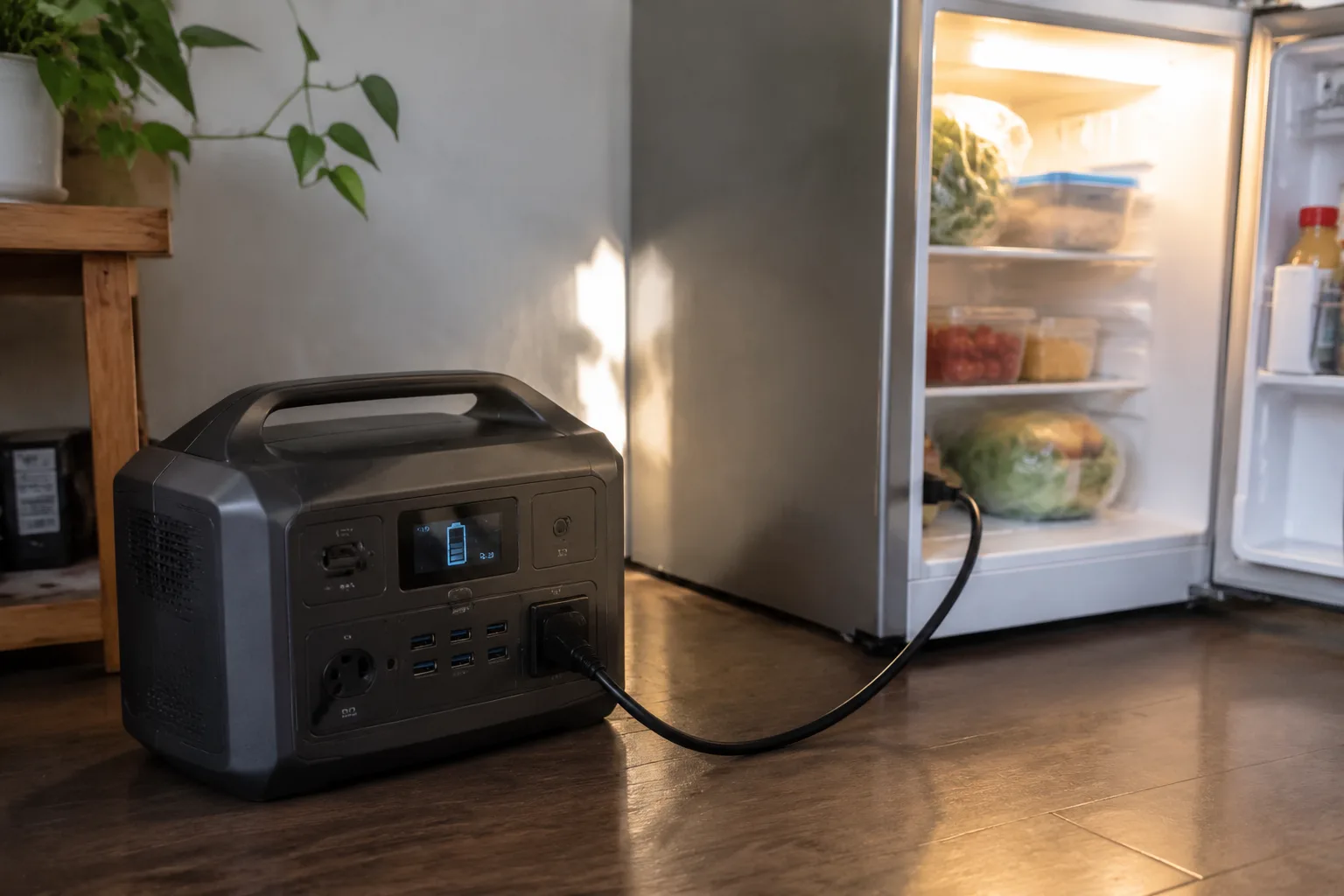
A refrigerator compressor draws somewhere between 100 and 200 watts while it is running, but that figure is nearly useless for sizing a portable power station. The number that matters is the surge: the brief spike of current when the compressor kicks on, often two to three times the running load. A 150-watt fridge can pull 400 watts for a second or two, and a power station rated at 500 watts continuous can stumble on that spike if its inverter is not built for it.
Most people who buy a power station for outage backup discover this the hard way, in the dark, after the unit shuts itself off. The math looks simple until the fridge cycles on.
Here is how the sizing actually works, and where the honest margins sit.
The refrigerator's real power profile
A modern 18-cubic-foot fridge uses roughly 1 to 1.5 kilowatt-hours per day in normal kitchen conditions, which works out to an average draw near 50 to 60 watts. That average hides everything interesting. The compressor runs in bursts, maybe 20 to 40 percent of the time depending on ambient temperature and how often the door opens. When it runs, it pulls its rated load. When it starts, it pulls far more.
The EnergyGuide label pasted inside the door is the most reliable public number a person has. It states estimated annual electricity use in kilowatt-hours. Divide by 365 for daily consumption. A fridge labeled at 400 kWh per year uses about 1.1 kWh a day. That label reflects standardized test conditions, which are gentler than a hot August kitchen, so treat it as a floor rather than a ceiling.
Older units drift upward. A 2005-era fridge with worn door gaskets can easily double the label figure. Frost buildup on the evaporator coils adds run time. A fridge crammed into a hot garage may run nearly continuously in summer.
Why surge watts break undersized inverters
Compressor motors are inductive loads. At the instant of startup, the rotor is stationary and the magnetic field has to build from nothing, so the motor briefly behaves almost like a short circuit. The current spike lasts a fraction of a second, but the inverter has to supply it or fault out.
A power station's spec sheet lists two wattage figures: continuous and peak. Continuous is what the inverter sustains indefinitely. Peak is a short-term ceiling, usually lasting a few seconds. The gap between them matters. A unit rated 600 watts continuous and 1200 watts peak will start most household fridges. A unit rated 500 continuous and 550 peak will not, no matter how large its battery is. Battery capacity is irrelevant if the inverter trips.
This is the single most common sizing mistake. Buyers compare battery watt-hours and ignore the peak rating, then find the station shuts down every time the compressor cycles.
Matching battery capacity to overnight runtime
Once the peak rating clears the surge, capacity decides how long the fridge stays cold. A 1 kWh battery running a fridge that averages 55 watts gives roughly 18 hours of pure fridge runtime, ignoring inverter losses. Real-world efficiency of maybe 85 percent pulls that down to about 15 hours.
That sounds generous until the fridge has to share. A power station rarely runs only a refrigerator during an outage. It runs a few LED lamps, a phone charger, maybe a router. Those loads add up in the background, and every watt-hour spent on lighting is a watt-hour not spent keeping the freezer at zero degrees.
A sensible target for a single fridge plus minimal incidentals sits between 1 and 2 kWh of usable capacity. Below 1 kWh, the runtime gets thin for an overnight outage. Above 2 kWh, the unit gets heavy and expensive fast, and the marginal runtime buys little for a fridge that will be opened less and less as the outage drags on.
The refrigerator that never gets opened stays cold longest
Behavior matters as much as hardware. A closed refrigerator holds temperature for hours. The USDA's food safety guidance treats a fridge as safe for about four hours without power if the door stays shut, and a full freezer considerably longer. Every door opening dumps cold air and forces the compressor to work when it comes back.
During an outage, the power station's job is partly to buy time and partly to preserve food quality across a longer event. A fridge kept sealed and backed by a modest station will outperform a larger station behind a fridge opened every twenty minutes out of anxiety.
Reading the labels without getting fooled
Manufacturers quote peak wattage generously. Some list a peak that lasts only half a second, which a compressor surge can outlast. Others rate peak at a temperature the unit will never see in a summer garage. The honest approach is to leave headroom: pick a station whose continuous rating exceeds the fridge's running watts by at least double, and whose peak rating clears three times the running load.
A fridge drawing 150 running watts wants a station with 300 watts continuous and 450 watts peak at minimum. In practice, most buyers land on units in the 500 to 1000 continuous range simply because that is where the market sits, and the extra headroom absorbs the surprise loads.
Ambient temperature deserves a mention here. Inverter electronics derate in heat. A station rated 600 watts at 77 degrees may only deliver 500 at 95 degrees. A garage in July is a hostile environment for the very device meant to keep the garage fridge alive.
Compressor fridges versus absorption and DC models
Not every refrigerator draws power the same way. Standard kitchen fridges use reciprocating compressors with hard startup surges. Propane absorption fridges, common in RVs, draw almost nothing electrically but need a heat source. DC compressor fridges, popular in overlanding and van builds, use brushless motors with soft-start controllers and sip power, often under 60 watts running with no meaningful surge.
For a DC fridge, a 500 Wh station might run it for a full day or more. For a standard AC kitchen fridge, the same station might manage six hours. The appliance determines the sizing far more than the station does.
What a realistic outage actually looks like
Most residential outages in the United States last under four hours, according to utility industry reporting, with a long tail of multi-day events after storms. That distribution shapes the right purchase. A station sized for a 12-hour fridge run covers the overwhelming majority of events. A station sized for three days is a different product class, often with an expansion battery or a transfer switch.
The practical recommendation lands on a unit with at least 1 kWh of capacity, a continuous inverter rating of 500 watts or more, and a peak rating that clears the fridge's surge with margin. That covers a standard fridge through a long evening and overnight, with room for a lamp and a phone.
Anything smaller is a gamble on the compressor's mood. Anything much larger is a bet on an outage that statistics say is rare, and the money might be better spent on a transfer switch and a generator that also runs the furnace.
The number to write on the box before the storm arrives
Pull the EnergyGuide label off the fridge, divide the annual kWh by 365, and treat that as the daily draw. Multiply the fridge's nameplate running amps by 120 volts for running watts, then triple it for surge. Write those two figures on a piece of tape inside the pantry door. When a storm warning appears and the power station gets dragged out of the closet, the tape answers the question in five seconds instead of an hour of panicked spec-sheet scrolling.
The tape also settles the argument at the hardware store. A station that cannot clear the surge number on the tape is the wrong station, regardless of what the box promises about watt-hours.