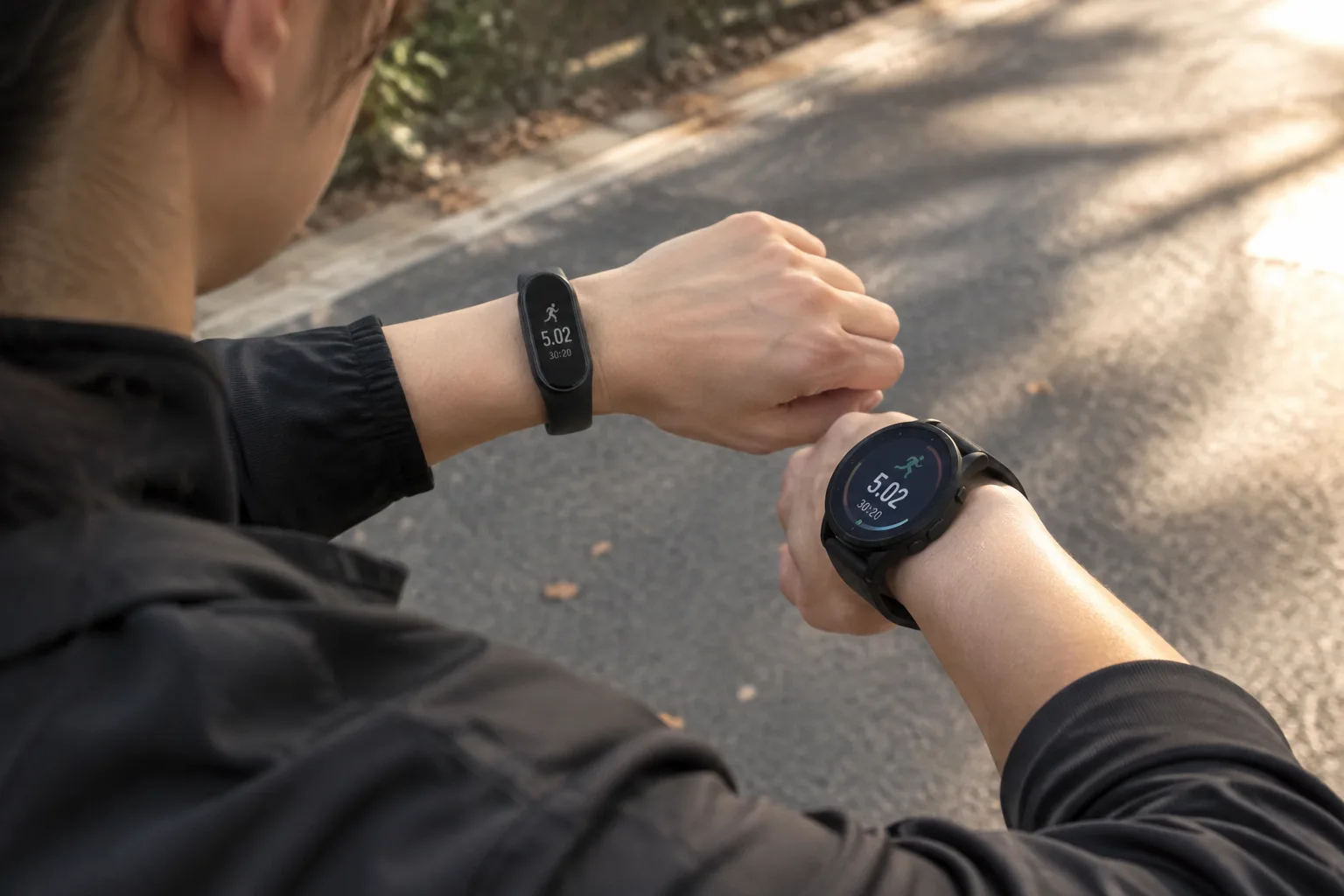
A runner finishing a marathon looks down at a wrist and sees a number that tells the truth about the last 26.2 miles. That number came from a device strapped there for hours, sampling a pulse of light through skin, counting arm swings, and reconciling the whole mess against a GPS signal that drifted between skyscrapers. The question of whether that device should be a fitness tracker or a smartwatch is, in practice, a question about how much the runner wants the wrist to do besides running.
Most runners own some piece of wrist hardware already. The market has blurred the line between the two categories so thoroughly that a shopper can spend $200 on either and come home with a device that counts steps, reads heart rate, and pushes phone notifications. The blurring is real, but the categories underneath still differ in ways that matter on a Tuesday morning long run and again on a Thursday evening when the watch sits on a charger.
The honest answer is that most runners belong in a fitness tracker, and the runners who genuinely need a smartwatch are a smaller group than the marketing suggests. The rest of the field is a set of tradeoffs worth understanding before spending money.
The battery math that decides most arguments
A dedicated running watch from a company like Garmin or Coros routinely clears a week between charges, and some models stretch to two or three weeks when GPS stays off. A mainstream smartwatch typically needs a nightly charge, and a long GPS workout drains it faster. That difference is not a spec sheet curiosity. It changes behavior.
A device that needs charging every night invites the runner to leave it on the nightstand and forget it before a dawn run. A device that lasts a week lives on the wrist, which is the entire point of wearing something that measures training. The best tracker is the one that is present for the easy runs too, not just the sessions worth posting.
Sleep tracking complicates this slightly. Watches that monitor sleep need to be worn overnight, and a device that already needs a nightly top-up can be charged during a shower or a commute instead. It works, but it demands a routine. Runners who travel, who race early, or who simply forget things tend to feel that routine as friction.
GPS accuracy separates the serious from the casual
Both categories now pull satellite fixes, and both can be wrong. The difference shows up in the trees. A smartwatch riding a single-band GPS chip will cut corners on a wooded trail, drawing a route that hops through the forest instead of following the switchbacks. A running-focused watch with dual-band positioning holds the line far more reliably, and the gap grows in cities where tall buildings bounce signals around.
For a runner logging miles on open roads, the discrepancy is a rounding error. For a trail runner measuring a technical loop, it can mean a half mile of phantom distance over a two-hour effort. Pace data built on that drift becomes useless, and the training log quietly fills with numbers that do not reflect what happened.
There is a subtler point about how each device handles a workout. Fitness trackers and running watches tend to offer structured workouts, lap buttons that respond instantly, and screens built around pace, heart rate zones, and cadence. A smartwatch can do some of this through apps, but the interaction is often a tap-and-scroll affair with a touchscreen that misreads a sweaty finger. Mid-run, that friction is the difference between hitting a split and fumbling through a menu.
Heart rate sensors and the wrist that lies
Optical heart rate sensors on the wrist share a common weakness: they struggle when the watch shifts, when the skin is cold, and when the arm is moving in ways that break contact with the sensor. Tightening the strap helps. So does wearing the device a bit higher on the forearm. Neither fixes the fundamental issue that a wrist is a noisy place to measure a pulse.
Running watches and fitness trackers handle this differently in software. A dedicated training device often pairs with a chest strap and treats that external sensor as the authoritative source, dropping the wrist reading when the strap is connected. Smartwatches can pair with straps too, but the ecosystem around serious training data is thinner, and the workout summaries tend to emphasize calorie burn and activity rings over zone time and aerobic drift.
A runner who only wants a rough sense of effort will find either category adequate. A runner building a base, chasing a personal best, or following a plan with prescribed heart rate zones will want the device that treats the strap as the source of truth and the wrist as a backup.
The apps that hold a training log together
Data is only as good as the place it lands. Running-focused watches push clean files to platforms like Strava, TrainingPeaks, and the manufacturer's own dashboard, with laps, splits, elevation, and zone breakdowns intact. The sync is boring and reliable, which is exactly what a training log needs.
Smartwatches sync too, but the path is sometimes indirect. A workout recorded in a third-party app on the watch may route through the phone, and the file that arrives at Strava can lose lap structure or arrive with a delayed timestamp. None of this is catastrophic. It is the kind of small tax that accumulates over a season until the runner stops trusting the numbers.
The other side of the ledger is convenience. A smartwatch answers a call, replies to a text, and runs a timer for intervals without reaching for a phone. For runners who train with a phone tucked away and want to stay reachable, that is a genuine benefit, and it explains why so many people wear one on easy days and a dedicated watch on hard ones.
Weight, fit, and the wrist that notices
A running watch built for training is often light, sometimes under 40 grams, with a strap that stays put through sweat and rain. A smartwatch with a metal case and a glass face can weigh twice that, and the mass becomes noticeable over a long effort. Runners who swing their arms freely will feel a heavier device move, and the sensor underneath will feel it too.
Fit matters in a quieter way. A bulky case can catch on a jacket sleeve, sit awkwardly under a cuff, and press against the wrist bone during push-ups or a plank. Runners who cross-train will notice. Runners who race in a singlet will notice less, but the wrist is a small joint and a heavy object on it is a persistent reminder.
There is also the question of what the device looks like when it is not running. A fitness tracker or running watch reads as athletic gear, which is fine at a trailhead and slightly odd at a formal dinner. A smartwatch reads as a watch, which is why some runners wear one for the office and swap to the other for the workout. That swap is a small ritual and a small cost.
The swim, the bike, and the multisport problem
Runners who also swim or bike face a decision point. A fitness tracker often handles pool swims with a lap count and a stroke estimate, and some handle open water with GPS. A running watch usually supports multiple sport profiles and can stitch a brick workout together without breaking the file. A smartwatch can do these things through apps, but the experience is uneven across brands and sports.
Triathletes already know this. The transition between sports is where a device either keeps recording or fumbles, and a touchscreen that locks up in the water is a known irritation. Buttons work when wet. That is a small design detail that separates a device built for training from a device built for general life.
Price, and what the extra money actually buys
Entry-level fitness trackers sit well under $100 and cover steps, heart rate, sleep, and basic GPS. Mid-range running watches land in the $200 to $350 band and add better GPS, structured workouts, and longer battery. Premium smartwatches climb past $400 and add cellular connectivity, a bigger screen, and a full app ecosystem.
The money question is not which device has more features. It is which features a runner will actually use on a wet Wednesday. A cellular connection is useful if the runner wants to leave the phone at home and still be reachable. A bigger screen is useful for reading a map on a trail. Neither is useful if the battery dies at mile 18.
A runner spending $300 on a mid-range running watch gets a device that will still be tracking accurately three years later. A runner spending $400 on a smartwatch gets a device with a richer life and a shorter useful span, because software support and battery health tend to fade faster on the more complex product. That is a real cost, even if it never appears on the receipt.
The runner who should buy the smartwatch anyway
There is a runner for whom the smartwatch is simply the right call. That runner trains three or four times a week, runs for fitness and head-clearing rather than a race calendar, wants to see a text from a partner during a long run, and would rather charge one device than manage two. For that runner, the training features of a dedicated watch are surplus, and the convenience of a smartwatch is the whole point.
The mistake is buying the smartwatch for the running features and then being disappointed when the battery dies on a weekend long run. The device is not failing. It was built for a different job. A runner who wants a phone on the wrist should buy a phone on the wrist and accept the charging routine that comes with it.
The runner who keeps a paper training log, races twice a year, and wants splits that match the course map should buy the tracker or the running watch. The runner who wants a wrist that handles life and running at once should buy the smartwatch and stop apologizing for it. Both choices are defensible. The mistake is pretending the categories are the same, then blaming the device when the difference shows up at mile 20 with a dead battery.